InfoSAWIT, TANAH BUMBU – Indonesia’s government is looking to expand palm oil-cattle integration programs nationwide after a successful model in South Kalimantan demonstrated its potential to boost domestic beef production and reduce the country’s reliance on imported cattle and meat.
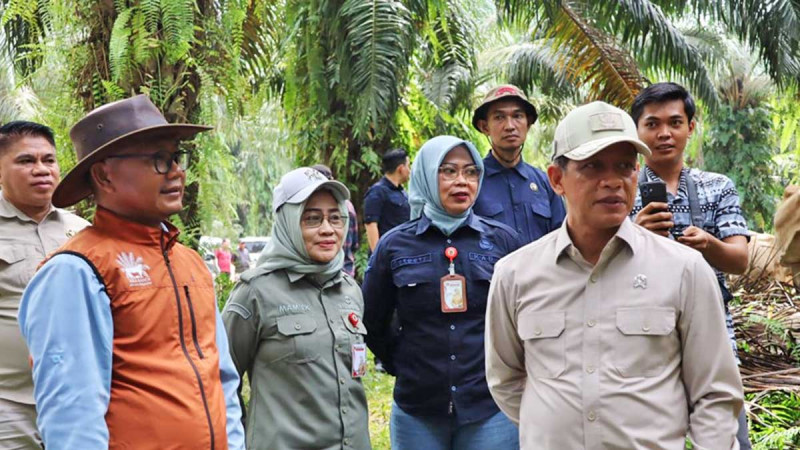
The initiative gained renewed attention following a visit by Deputy Coordinating Minister for Food Affairs Hanif Faisol Nurofiq to PT Buana Karya Bhakti’s SISKA KU INTIP (Integrated Palm Oil-Cattle Partnership Program) in Satui District, Tanah Bumbu Regency.
During the visit, Hanif highlighted the program as a practical example of how Indonesia’s vast oil palm plantations can be leveraged to strengthen national food security while improving plantation efficiency.
“What appears to be a simple model actually has tremendous potential to increase domestic cattle availability. The natural breeding system implemented here has proven effective in growing livestock populations,” Hanif said in a statement cited by InfoSAWIT on Thursday.
From 300 to 1,500 Head of Cattle
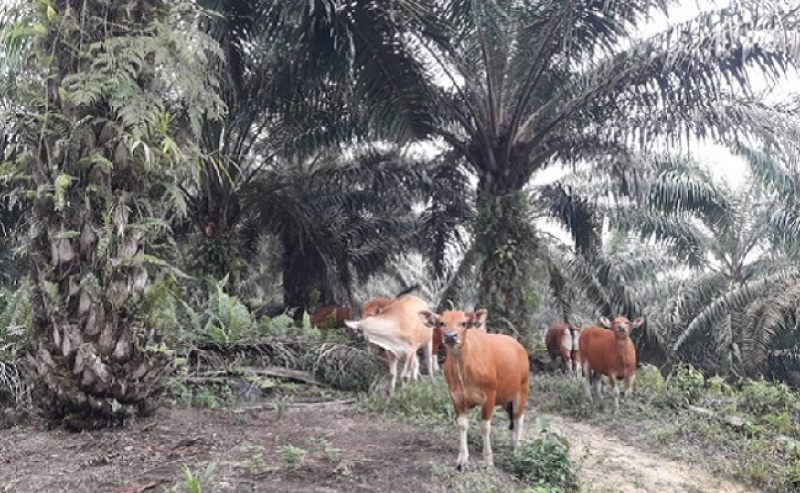
The integrated farming system began in 2016 with approximately 300 cattle. Today, the herd has expanded to nearly 1,500 head through a natural breeding approach within plantation areas.
The success of the program has reinforced the government’s belief that closer integration between the plantation and livestock sectors could become a strategic solution to Indonesia’s longstanding beef supply challenges.
South Kalimantan alone offers significant expansion opportunities. Of the province’s estimated 480,000 hectares of oil palm plantations, around 250,000 hectares are considered suitable for integrated cattle farming.
According to government estimates, fully utilizing this potential could support at least 20,000 cattle, helping address the province’s current livestock deficit.
National Potential Reaches 1.3 Million Cattle
Hanif noted that the concept could be replicated across Indonesia’s palm-growing regions. With the country’s oil palm area exceeding 17 million hectares, integrated palm-cattle systems could potentially support as many as 1.3 million cattle nationwide.
“If implemented on a larger scale, the contribution to national beef supply would be substantial,” he said.
Indonesia currently consumes around 800,000 tonnes of beef annually, while domestic production supplies only about half of that demand. The remaining shortfall is met through imports from major exporting countries.
Government officials believe expanding integrated livestock systems could play an important role in narrowing this gap and strengthening food self-sufficiency.
Benefits Beyond Livestock Production
The integration model also delivers direct benefits to plantation operations.
Grazing cattle help control weeds naturally, reducing plantation maintenance costs by an estimated 50–70 percent. In addition, livestock manure can be utilized as organic fertilizer, improving soil fertility and supporting palm productivity.
PT Buana Karya Bhakti Ranch Manager Wahyu Darsono said the company initially invested around Rp6 billion to purchase 300 cattle and establish supporting facilities.
“Our herd has now reached approximately 1,500 head. Male cattle are marketed annually, particularly ahead of Eid al-Adha, while female cattle are retained as breeding stock to sustain population growth,” Wahyu explained.
Recognized as a National Role Model
The program has attracted national attention and has been designated by Indonesia’s Directorate General of Livestock and Animal Health Services as a model project for integrated plantation-livestock development.
South Kalimantan Plantation and Livestock Agency Head Suparmi said the initiative demonstrates how collaboration between plantation companies, local governments, and other stakeholders can create sustainable economic and food security benefits.
Industry observers believe the model could become increasingly important as Indonesia seeks innovative approaches to improve domestic beef production while maximizing the productivity of its plantation sector. (T2)