InfoSAWIT, JAKARTA – State-owned plantation company PT Agrinas Palma Nusantara (Persero) is expanding its sustainability-driven business transformation through a strategic partnership initiative with a South Korean consortium aimed at developing palm biomass-based green energy and accelerating downstream palm oil industries.
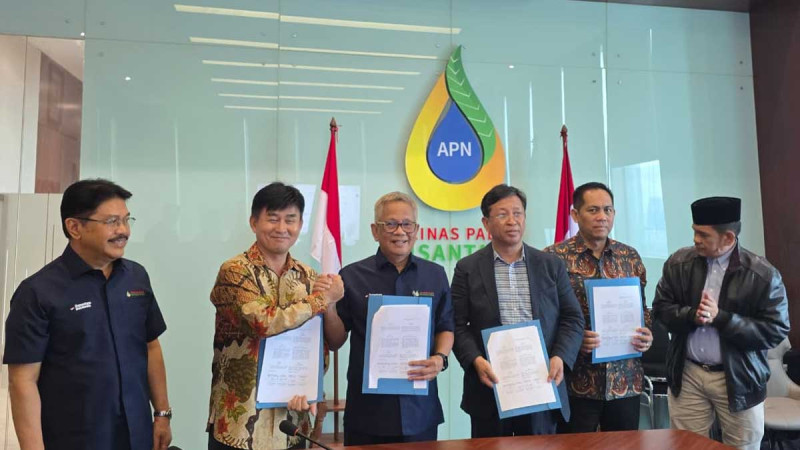
The collaboration opportunity emerged during a business meeting in Jakarta involving Agrinas Palma’s management team and representatives from several South Korean technology and investment firms. Discussions focused on biomass utilization, renewable energy development, and expanding export opportunities for value-added palm-based products.
The meeting was led by Agrinas Palma Nusantara President Director Mohammad Abdul Ghani, accompanied by Operations Director Tuhu Bangun and Business Director Nurhidayat. Representatives from the Korean consortium included Park Geoungduk, President Director of PT Astrum Dunia Inovasi; Lim Daetaeg, President Director of Hwasung Tech-Win Co., Ltd.; and Tommy Julius R. L., President Director of PT Siborong Nusa Gemilang.
A key topic of discussion was the potential conversion of oil palm empty fruit bunches (EFB) into environmentally friendly products with significant commercial value. Products under consideration include biochar, biopellets, carbon-based fertilizers, and biodiesel.
According to Ghani, biomass utilization is becoming a central pillar of Agrinas Palma’s strategy to create a more sustainable plantation business model that balances economic growth with environmental responsibility.
“Green energy development and biomass utilization are part of Agrinas Palma’s commitment to building a business that delivers economic value while creating positive impacts for both the environment and local communities,” Ghani said in a statement received by InfoSAWIT on Thursday.
Palm Biomass Emerging as a New Value Driver
Ghani emphasized that partnerships with international technology providers are crucial to accelerating Agrinas Palma’s transformation into a globally competitive agro-industrial company.
Beyond improving plantation management efficiency, the collaboration is expected to unlock new opportunities for downstream products capable of reaching international markets.
The South Korean consortium introduced several biomass processing technologies that could potentially be integrated into Agrinas Palma’s existing palm oil operations. These technologies are designed not only to produce renewable energy and eco-friendly materials but also to support carbon emission reduction efforts.
Industry observers note that palm biomass utilization is becoming increasingly relevant as global demand for clean energy and low-carbon raw materials continues to rise. In addition to generating new revenue streams, biomass-based products may also contribute to emerging carbon trading schemes in various markets.
Feasibility Studies to Determine Next Steps
As a follow-up to the discussions, both parties agreed to exchange technical data, prepare cooperation proposals, and conduct feasibility studies to identify the most viable and profitable business models.
The initiative forms part of Agrinas Palma Nusantara’s broader strategy to strengthen international partnerships while supporting Indonesia’s national agenda on palm oil downstreaming, energy transition, and sustainable green economic development.
With Indonesia possessing one of the world’s largest palm biomass resources and South Korea offering advanced processing technologies, the partnership could create new opportunities for the development of a competitive renewable energy industry based on the country’s plantation sector.
The collaboration also highlights growing international interest in Indonesia’s palm biomass potential as industries worldwide seek sustainable alternatives to conventional energy sources and carbon-intensive materials. (T1)