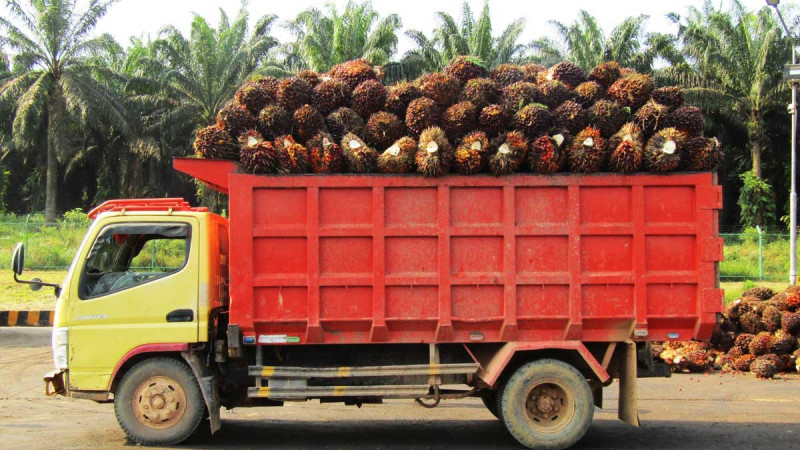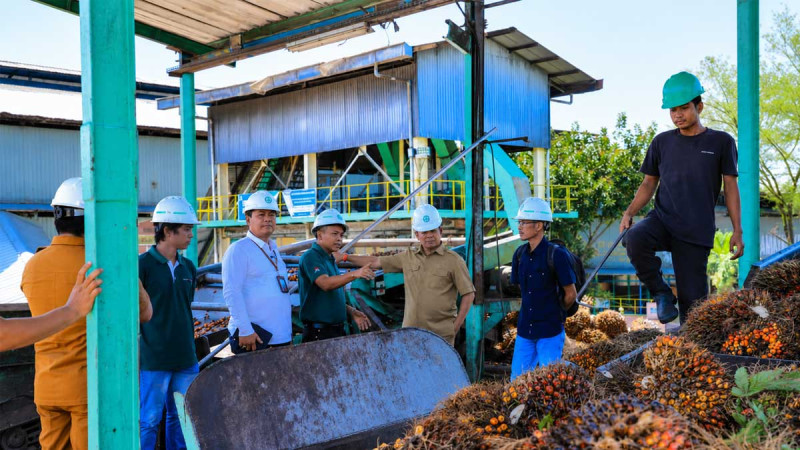
InfoSAWIT, ROKAN HULU – Rokan Hulu Deputy Regent H. Syafaruddin Poti conducted surprise inspections at several palm oil mills (PKS) across Rokan Hulu Regency, Riau, following complaints from oil palm smallholders over Fresh Fruit Bunches (FFB) prices that remain below the benchmark set by the provincial government.
The inspections were carried out alongside officials from the Rokan Hulu Livestock and Plantation Agency (Disnakbun), the Environmental Agency (DLH), and the Regional Trade and Industry Office’s Metrology Division. The team visited three palm oil mills: PT Sumatera Karya Agro (SKA), PT Sawit Asahan Indah (SAI) in Rambah Samo District, and PT Rohul Sawit Industri (RSI) in Ujung Batu District.
During the visits, the delegation was received by company representatives, including public relations officers, mill managers, and FFB procurement staff.
Field observations revealed significant disparities in FFB purchasing prices, particularly for independent smallholders. While plasma farmers generally received prices closer to government benchmarks, independent growers continued to face lower buying prices.
At PT SKA, FFB was reportedly purchased at around Rp3,100 per kilogram, while PT SAI offered approximately Rp2,840 per kilogram.
“We came directly to the field to verify the actual situation. Our monitoring shows that some mills are still purchasing FFB below government benchmarks. This is a serious concern because it directly affects the livelihoods and welfare of our oil palm farmers,” Syafaruddin said, as reported by the Rokan Hulu Regency Administration.
Regency Pushes Formal Partnerships Between Mills and Smallholders
As part of a long-term solution, the Deputy Regent urged all palm oil mills, particularly those without their own plantations, to establish formal partnerships with independent smallholders through recognized institutions such as farmer groups (Koptan), farmer group associations (Gapoktan), and village cooperatives (KUD).
According to Syafaruddin, such partnerships should be formalized through binding agreements requiring mills to purchase FFB in accordance with prices determined by the Riau Provincial Plantation Agency under Governor Regulation No. 77 of 2020.
“If companies partner with farmers through cooperatives or farmer organizations, there must be clear and binding agreements. One key requirement is that FFB purchasing prices must follow government-established benchmarks,” he explained.
He added that partnerships should go beyond simple buying and selling arrangements. Companies are expected to support farmers through technical assistance, plantation management training, and productivity improvement programs.
“Partnerships are not only about purchasing farmers’ fruit. Companies should also help improve cultivation practices, plantation maintenance, and productivity. Better fruit quality ultimately benefits both farmers and processors,” he said.
Traders Warned Against Pressuring Smallholder Prices
Syafaruddin also warned traders and collection point operators against taking advantage of market conditions to suppress FFB prices paid to independent farmers.
“We urge traders and collection point owners not to use current market conditions as an excuse to depress smallholders’ FFB prices. We want all stakeholders to help maintain price stability and protect farmers’ incomes,” he stressed.
As a follow-up to the inspections, the Rokan Hulu administration plans to summon all palm oil mill operators in the regency to discuss FFB pricing and accelerate partnership programs between mills and farmer organizations.
Meanwhile, the Rokan Hulu Plantation Agency announced it would intensify daily monitoring of FFB prices across all mills. The collected data will be reported regularly to the Riau Provincial Plantation Agency and the Directorate General of Plantations at the Ministry of Agriculture to support policy evaluation and future regulatory measures. (T2)