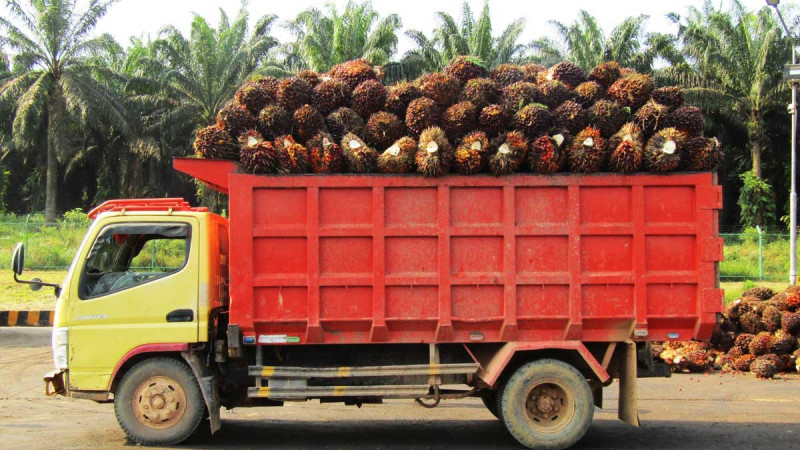
InfoSAWIT, JAKARTA – Indonesia recorded another trade surplus in April 2026, extending an uninterrupted surplus streak that has now reached 72 consecutive months since May 2020. Palm oil and its derivative products continued to be the country’s largest contributor to foreign exchange earnings, supporting the national trade balance.
Trade Minister Budi Santoso reported that Indonesia posted a trade surplus of US$90 million in April 2026. The result was supported by a non-oil and gas surplus of US$3.53 billion, which offset a US$3.44 billion deficit in the oil and gas sector.
“Cumulatively, Indonesia’s trade balance recorded a surplus of US$5.64 billion during January–April 2026. This was driven by a non-oil and gas surplus of US$14.16 billion, despite an oil and gas deficit of US$8.52 billion,” Santoso said in an official statement.
Although positive, the four-month surplus remains below the US$11.07 billion recorded during the same period in 2025.
Palm Oil Leads Non-Oil Trade Surplus
Data from the Ministry of Trade show that the animal and vegetable fats and oils category (HS 15), dominated by palm oil and downstream products, generated the largest trade surplus during the first four months of 2026, reaching US$11.71 billion.
The figure significantly exceeded surpluses from mineral fuels (HS 27), which reached US$8.34 billion, and iron and steel products (HS 72), which contributed US$5.71 billion.
On the import side, Indonesia’s largest trade deficits were recorded in machinery and mechanical equipment (HS 84), electrical machinery and equipment (HS 85), and plastics and plastic products (HS 39).
The United States remained Indonesia’s largest source of non-oil trade surplus at US$6.81 billion, followed by India at US$4.44 billion and the Philippines at US$2.77 billion. Meanwhile, Indonesia’s largest bilateral trade deficit continued to be with China, totaling US$8.03 billion.
According to Santoso, the government is continuing efforts to diversify export markets and accelerate downstream industrial development to reduce dependence on global commodity price fluctuations.
Palm Oil Exports Surge Nearly 39%
Indonesia’s total exports reached US$25.30 billion in April 2026, up 12.32% from March and 21.98% higher than the same month last year.
The increase was driven primarily by non-oil exports, which rose 13.66% month-on-month, while oil and gas exports declined 9.81%.
Among the strongest-performing sectors was the animal and vegetable fats and oils category, which grew by 38.71% compared with the previous month. Significant gains were also recorded in coffee, tea and spices, tobacco products, wood products, and machinery exports.
Demand from several key markets also accelerated sharply, with exports to the United Arab Emirates rising 305.21%, South Africa 288.40%, and Belgium 117.84% compared with March 2026.
Manufacturing Drives Export Growth
During January–April 2026, Indonesia’s total exports reached US$92.15 billion, representing growth of 5.48% year-on-year.
Non-oil exports climbed 6.28% to US$87.74 billion, while oil and gas exports contracted 8.30% to US$4.41 billion.
Santoso said manufacturing remained the primary engine of export growth, expanding 9.78% year-on-year. Products posting the strongest gains included nickel and nickel products, aluminum, organic chemicals, copper products, and tin products.
The minister attributed the growth to strong global demand and favorable international commodity prices, which supported Indonesia’s manufacturing export performance.
Africa and the Middle East Offer New Opportunities
Several non-traditional export markets continued to gain importance during the first four months of 2026. Egypt recorded import growth of 42.74% from Indonesia, followed by Spain, South Africa, Hong Kong, and China.
Growing demand was also reported in Central Asian countries such as Uzbekistan, Tajikistan, and Turkmenistan, as well as markets across North and Southern Africa.
The trend is viewed as a strategic opportunity for Indonesian industries, including the palm oil sector, to expand market penetration and strengthen Indonesia’s position as one of the world’s leading commodity exporters. (T2)