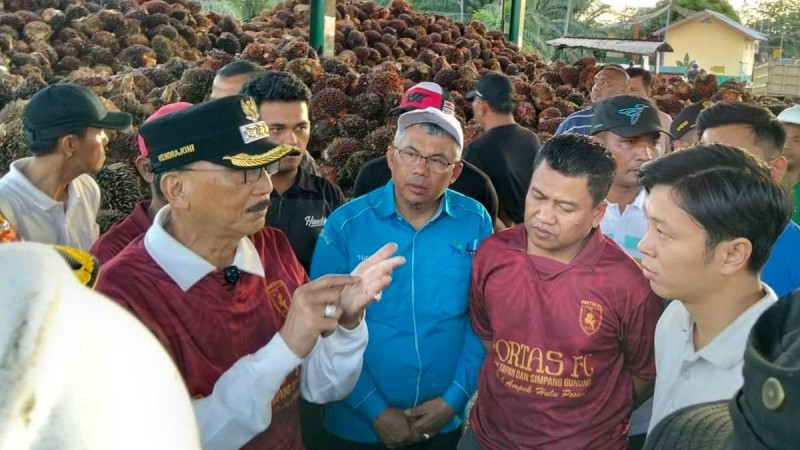
InfoSAWIT, PESISIR SELATAN – Declining fresh fruit bunch (FFB) prices in Pesisir Selatan Regency, West Sumatra, have prompted direct intervention from local authorities. Pesisir Selatan Regent Hendrajoni visited the palm oil mill of PT Kemilau Permata Sawit in Nagari Kubu Tapan, Ranah Ampek Hulu Tapan District, on Monday to assess the situation and engage with company management.
The visit involved regional legislators and government officials, including Pesisir Selatan Regional House of Representatives (DPRD) Chairman Darmansyah, Deputy Chairmen Hakimin and Dani Sopian, along with several heads of local government agencies.
The inspection followed Circular Letter No. 521.3/114/DPTPH/V-2026 issued by the West Sumatra Provincial Government on 25 May 2026, urging local administrations to safeguard FFB price stability and maintain conducive conditions following natural resource export governance policies.
The provincial government warned companies against using export governance policies as justification for suppressing Smallholders’ FFB prices. Local governments were also instructed to strengthen oversight over pricing practices, prevent unilateral price reductions, avoid discriminatory fruit acceptance policies, monitor grading standards, and ensure timely payments to farmers.
Speaking before PT Kemilau Permata Sawit management, Regent Hendrajoni stressed that FFB prices for farmers in Pesisir Selatan should remain competitive with neighbouring regions.
“Prices must not go down, although increases are welcome. This is in line with the governor’s instruction,” Hendrajoni said, as reported by the Pesisir Selatan Regency administration.
He explained that the government intentionally conducted field visits to understand conditions faced by both farmers and companies to obtain a comprehensive picture of the pricing issue.
“Based on the circular, we moved directly to the field to see the current conditions. Our farmers must not suffer losses. I believe PT Kemilau will respond positively to this issue,” he said.
Hendrajoni expressed hope that the visit would encourage a shared commitment between government and business actors to maintain stable palm oil prices in the region.
He also questioned the recent decline in palm oil prices occurring across several regions despite relatively stable international market conditions.
“We acknowledge that palm oil prices have fallen in many regions. Yet international prices, including in Europe, appear relatively stable. Why then are local prices falling? What policy is driving this? Ultimately, farmers are the ones affected,” he said.
The Regent compared local FFB prices with those in Bengkulu, where prices reportedly reached around Rp3,750 per kilogram, and called for further discussions with the company while awaiting decisions from the provincial government.
“I want local farmers’ FFB prices to improve and become comparable with Bengkulu. We will discuss this with the company while waiting for the provincial government’s decision,” he added.
Despite raising concerns over pricing, Hendrajoni acknowledged the economic benefits generated by PT Kemilau Permata Sawit’s operations.
“I heard directly from local residents that this mill has helped improve livelihoods and economic activity,” he said.
At the same time, he encouraged the company to contribute through corporate social responsibility programmes, including support for the construction of a jogging track in the Painan football field area.
Meanwhile, PT Kemilau Permata Sawit FFB Supervisor Erwin Saputra stated that current FFB prices stood at Rp2,350 per kilogram and had gradually increased in recent days.
“The current market price is Rp2,350 per kilogram. We have also gradually raised prices, with the latest increase reaching Rp200,” Erwin explained.
He attributed pricing differences between Pesisir Selatan and other regions in West Sumatra to several factors, including plantation soil conditions.
“Coastal plantations are generally located near the sea, while regions such as Sijunjung and Dharmasraya have mineral soils. Naturally, fruit quality differs,” he said.
Erwin noted that fruit deductions at the mill ranged between six and ten percent depending on weather conditions and moisture content during the rainy season.
He assured that fruit acceptance procedures continued to follow company standards and maintained that farmers’ fruit quality remained within normal parameters.
“We appreciate the Regent and his delegation for visiting our company. Any follow-up regarding pricing policies will be conveyed to management,” he said. (T2)