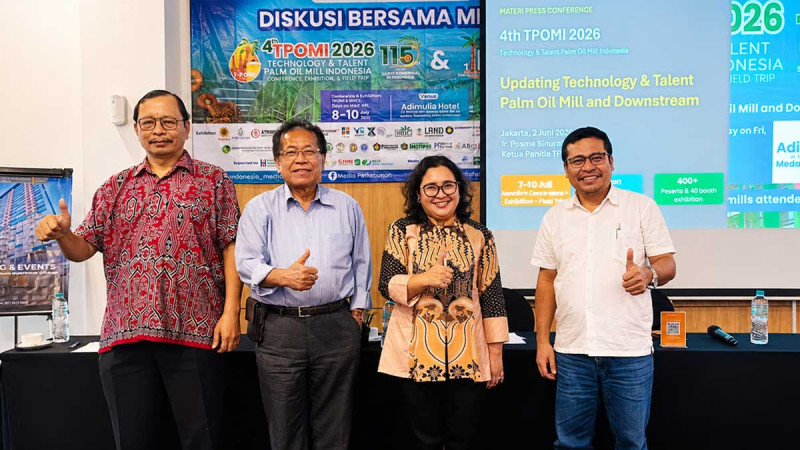
InfoSAWIT, JAKARTA – The 4th Technology and Talent Palm Oil Mill Indonesia (TPOMI) 2026 is being positioned as a strategic platform to accelerate transformation within Indonesia’s palm oil milling sector, particularly through technology modernization and talent development.
The message was delivered by Posma Sinurat, Chairman of the Palm Oil Mill Division of P3PI and Chairman of the 4th TPOMI 2026 Organizing Committee, during the TPOMI 2026 Press Conference attended by InfoSAWIT on Tuesday (2/6/2026).
According to Posma, TPOMI has evolved beyond a conventional industry gathering into a collaborative forum that brings together field practitioners, researchers, policymakers, businesses, technology providers, media, and students within Indonesia’s palm oil ecosystem.
“TPOMI 2026 is a platform for transforming technology and talent in Indonesia’s palm oil milling industry,” Posma said.
This year’s event carries added significance as Indonesia marks 115 years of commercial palm oil development, a milestone Posma described as an opportunity to move toward smarter and more precise palm oil mill operations.
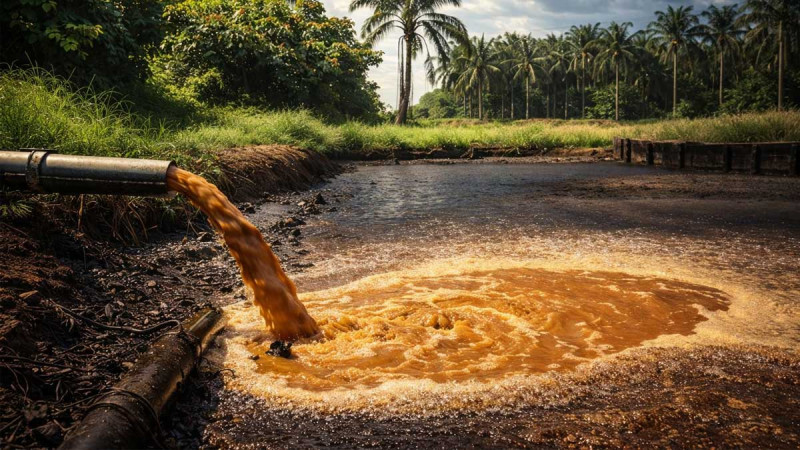
He noted that the milling industry continues to face a wide range of operational challenges, including oil losses, kernel losses, downtime, energy efficiency, occupational safety and health (K3), Palm Oil Mill Effluent (POME) management, workforce development, and digital transformation.
For that reason, TPOMI 2026 has been designed as an integrated event encompassing conferences, exhibitions, awards, and field visits.
The broader vision, Posma explained, is to support plantation downstreaming and strengthen palm oil’s role as a pillar of Indonesia Emas 2045.
The event series will begin on July 7 with the Medbun Awards, recognizing eight outstanding companies through main champion, runner-up, and appreciation categories.
The conference segment, scheduled for July 8–9, will address major industry themes including policy direction, mill technologies, occupational safety, energy efficiency, kernel loss management, carbon trading, biogas development, crude palm oil production, and B50 biodiesel implementation.
Running simultaneously from July 8–10, the exhibition is expected to feature around 40 booths showcasing technologies, engineering services, digital solutions, maintenance systems, energy innovations, and downstream palm oil technologies.
A field trip on July 10 will provide participants with opportunities for practical learning and industry networking.
Overall, TPOMI 2026 is expected to attract more than 400 participants from across industry, government institutions, academia, and the media.
One of the event’s core themes is technology upgrading aimed at shifting palm oil mills from reactive operational models toward smart, predictive, and data-driven systems.
According to Posma, technology adoption must produce measurable impacts on profitability through lower losses, reduced downtime, improved energy efficiency, and more accurate operational decision-making.
Several emerging technologies will take center stage during TPOMI 2026.
These include Artificial Intelligence (AI) for anomaly detection, loss prediction, and decision support systems; predictive maintenance technologies for early fault detection and downtime prevention; and Internet of Things (IoT) sensors capable of monitoring temperature, pressure, vibration, flow, levels, and energy consumption in real time.
Automation systems designed to stabilize operational parameters and minimize human error will also feature prominently.
Beyond operational efficiency, sustainability remains another major focus.
The event will address POME management, biogas development, biomass utilization, carbon trading opportunities, and energy efficiency strategies as part of broader efforts to build greener palm oil mills.
“Technology must be practical, measurable, and capable of delivering real impacts on efficiency, productivity, occupational safety, and mill sustainability,” Posma emphasized.
He acknowledged that TPOMI 2026 is made possible through extensive collaboration involving BPDP, GAPKI, BPJS Ketenagakerjaan, GIMNI, government institutions, sponsors, exhibitors, media partners, and other supporting organizations.
Posma also delivered a message to journalists and media organizations, encouraging stronger coverage of positive transformation within Indonesia’s palm oil sector.
“TPOMI 2026 is an opportunity to highlight a positive narrative—that Indonesia’s palm oil industry is moving toward becoming smarter, more efficient, safer, and more sustainable,” he concluded. (T2)