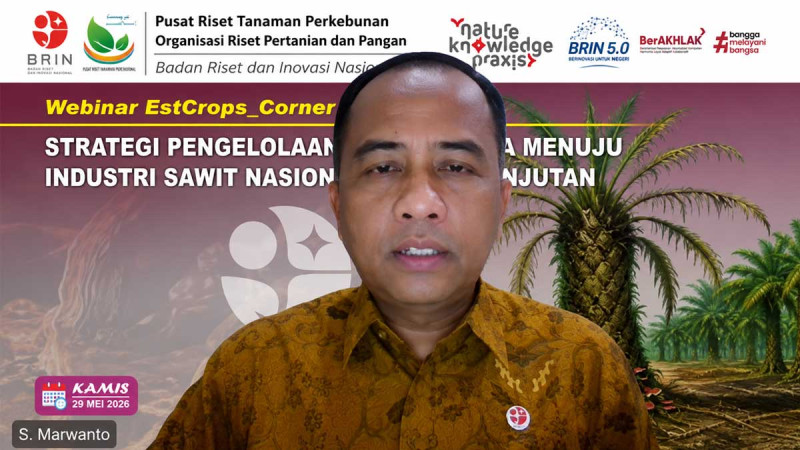
InfoSAWIT, JAKARTA – Indonesia’s National Research and Innovation Agency (BRIN) is accelerating research into oil palm seed innovation and disease detection technologies as part of broader efforts to address Ganoderma, a major threat to national palm oil productivity.
The initiative reflects growing concern over basal stem rot disease, which continues to undermine plantation performance and long-term industry sustainability.
Speaking during BRIN’s EstCrops_Corner #26 Webinar attended by InfoSAWIT on Friday (29/5/2026), Head of the Plantation Crop Research Center under BRIN’s Agriculture and Food Research Organization (ORPP), Setiari Marwanto, said increasing crude palm oil (CPO) production must go hand in hand with stronger disease mitigation.
“One of the most serious challenges facing Indonesia’s palm oil industry is basal stem rot disease caused by Ganoderma fungus,” Setiari said.
He explained that BRIN’s Plantation Crop Research Center is currently pursuing multiple research programs focused on disease control, crop resilience, and technology innovation to support more sustainable plantations.
Among BRIN’s main priorities is the development of early Ganoderma detection technology.
The research, initiated in 2025, is expected to support seed selection at early infection stages and help identify disease risks sooner.
“Development of Ganoderma detection technology began in 2025, and we hope it can assist seed selection during the early stages of infection,” he said.
Beyond early detection, BRIN has also launched breeding programs aimed at developing oil palm varieties with improved resistance to Ganoderma.
According to Setiari, the breeding initiative started in 2024 through collaboration with private-sector partners, reflecting the importance of developing planting materials capable of withstanding disease pressure under plantation conditions.
“Breeding programs to obtain Ganoderma-resistant oil palm varieties started in 2024 together with private partners,” he said.
BRIN is simultaneously advancing tissue culture and in vitro technologies to improve seed diversity and quality on a larger scale.
The programs are being carried out continuously with support from private companies to address rising demand for superior planting materials.
Despite these developments, Setiari acknowledged that current efforts remain insufficient without broader support and stronger collaboration.
“Our efforts are still far from sufficient. Greater resources and stronger collaboration are needed to accelerate Ganoderma control,” he stressed.
Through advances in early detection, resistant variety development, and high-quality seed technologies, BRIN hopes to build a more effective disease-management framework capable of protecting Indonesia’s palm oil productivity and long-term sustainability. (T2)