InfoSAWIT, JAKARTA – Indonesia’s oil palm industry continues to face a major threat from Ganoderma, the soil-borne fungus responsible for basal stem rot disease, which remains one of the most persistent challenges to plantation sustainability and productivity.
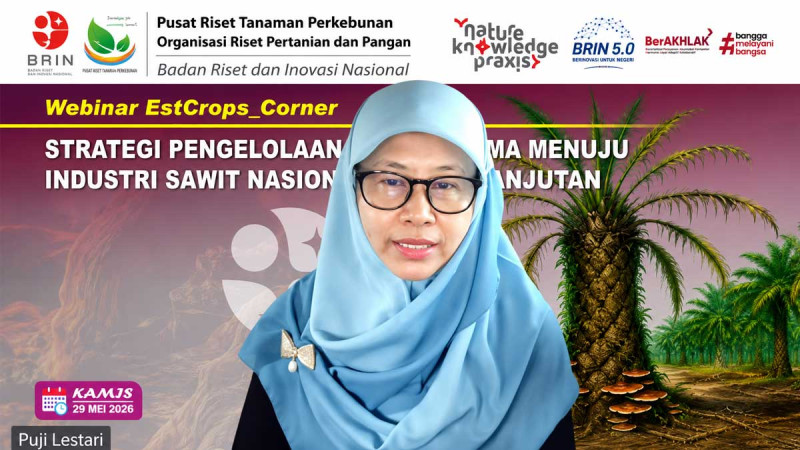
The issue took center stage during BRIN’s EstCrops_Corner #26 Webinar attended by InfoSAWIT on Friday (29/5/2026), where researchers and industry stakeholders discussed strategies to strengthen disease management across the national palm oil sector.
Head of the Agriculture and Food Research Organization (ORPP) at Indonesia’s National Research and Innovation Agency (BRIN), Puji Lestari, Ph.D., emphasized that oil palm plays a strategic role for Indonesia economically, socially, and environmentally.
According to her, the sector supports the livelihoods of more than 16.2 million families nationwide, making sustainable production inseparable from the industry’s ability to address cultivation challenges, particularly plant diseases.
“Oil palm offers enormous potential across various dimensions, but it also faces both biotic and abiotic challenges. One of the most serious concerns is Ganoderma as a soil-borne pathogen that limits production,” Puji said during the webinar.
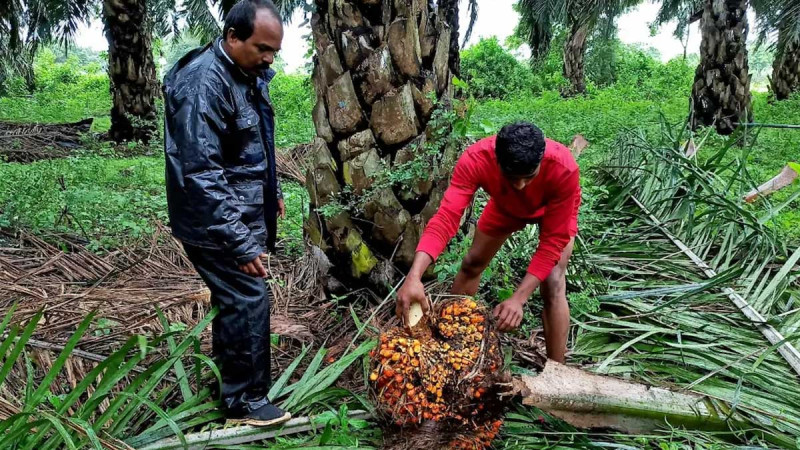
She noted that Ganoderma-induced basal stem rot has long haunted Indonesian plantations, attacking roots and lower stems before eventually killing infected palms.
The disease has become increasingly difficult to manage because it no longer affects only aging palms but also younger productive trees, while early-stage infections often remain undetected.
“To this day, the disease remains a serious challenge because early detection is difficult and its spread is extremely rapid,” she explained.
Puji stressed that technological innovation must become a core component of future disease management strategies. BRIN, she said, is promoting more precise and integrated monitoring systems capable of delivering faster and more accurate disease detection.
Such an approach, she added, would not only improve plantation monitoring but also help reduce operational expenses associated with excessive chemical use.
“How precision control measures are implemented and how we reduce operational costs caused by excessive chemical dependency are concerns we must address together,” she said.
BRIN is also encouraging wider adoption of biological agents and beneficial microbes as environmentally friendly alternatives for disease control.
According to Puji, bacterial applications and biological technologies could reduce dependence on chemical treatments while opening new pathways toward more sustainable plantation management.
She expressed hope that ongoing research programs would generate practical early-detection technologies and more effective disease-management systems suitable for field application.
“One of our hopes is that research and innovation can be optimally utilized to develop sustainable early-detection and disease-management solutions so that oil palm plantations are no longer continuously harmed,” she said.
Puji further highlighted the importance of stronger collaboration among research institutions, plantation companies, and research centers to ensure scientific findings move beyond laboratories and reach practical implementation across Indonesia’s palm oil industry.
With Ganoderma pressure increasing in many oil palm growing regions, BRIN views early detection and environmentally responsible disease management as critical pillars for maintaining Indonesia’s long-term palm oil sustainability. (T2)