InfoSAWIT, PADANG – The Sawitku Masa Depanku Palm Oil Smallholders Association (SAMADE) has welcomed the government’s new one-gate export policy for natural resource commodities, describing it as an opportunity for oil palm Smallholders to secure a stronger position within Indonesia’s palm oil industry value chain.
The policy, regulated under a Government Regulation on Natural Resource Commodity Export Governance, introduces a centralized export mechanism for strategic commodities through designated state-owned enterprises (SOEs).
Chairman of SAMADE West Sumatra, Junaindra Sumawan, said President Prabowo Subianto’s policy should not be viewed merely as a change in trading procedures, but as part of broader efforts to establish a more structured and nationally oriented commodity trade system.
Under the policy, exports of several strategic commodities—including crude palm oil (CPO), coal, and iron alloys—will be managed through appointed SOEs acting as single exporters. The government describes the scheme as a marketing facility, where SOEs serve as export gateways while sales proceeds continue to be transferred to commodity business operators.
According to Junaindra, stronger state involvement in export governance offers fresh hope for palm oil Smallholders, who have long occupied the lowest tier of the industry’s value chain.
“We welcome and appreciate President Prabowo’s decision. This is not merely an export regulation—it is a gateway toward Smallholder sovereignty,” Junaindra told InfoSAWIT on Tuesday (26/5/2026).
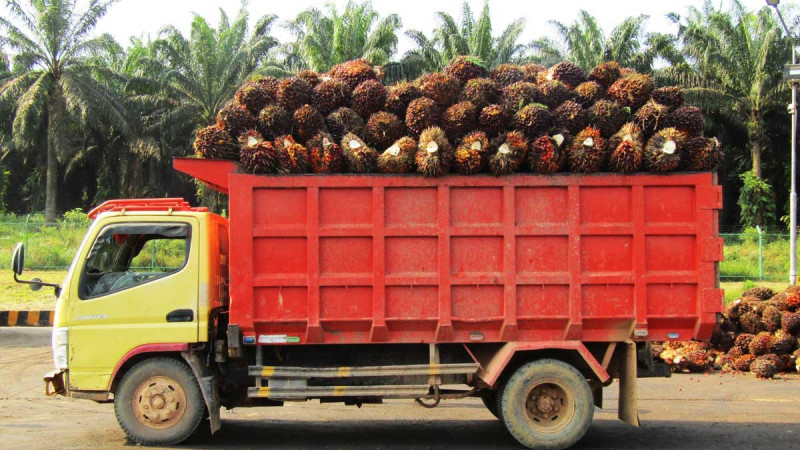
He explained that Smallholders have traditionally acted primarily as suppliers of Fresh Fruit Bunches (FFB), while most of the value-added gains have been concentrated in processing and trading sectors. For that reason, the one-gate export policy could create opportunities for farmers to participate more actively in downstream industries.
Opportunity for Smallholder-Based Mini Mills
One of the most promising opportunities, according to SAMADE, is the development of mini palm oil processing mills owned by farmer groups or cooperatives.
Junaindra argued that the biggest challenge faced by Smallholders has not only been financing and technology, but also market access—particularly export markets.
“When farmers want to build their own mills, the challenge is not just capital and technology, but also market access. With stronger state involvement in export governance, these difficulties are beginning to find solutions,” he said.
He stressed that Smallholders need support to move up the value chain through cooperatives, farmer groups, and farmer-owned enterprises so they can benefit not only from FFB prices but also from value-added palm products.
Junaindra further noted that the spirit behind the policy aligns with Indonesia’s economic sovereignty agenda, positioning the country not only as the world’s leading palm oil producer but also as a nation with stronger control over trade governance, pricing, and downstream industrial development. The government has previously stated that the one-gate export mechanism is intended to improve oversight of strategic commodity exports while curbing under-invoicing and transfer pricing practices.
Call for Smallholder-Friendly Regulations
SAMADE emphasized that implementation of the regulation should be followed by derivative policies that provide tangible support for Smallholders.
Among the proposals put forward are easier financing for mini-mill development, technical assistance for processing, guaranteed absorption of CPO produced by Smallholder-owned mills, and fair partnership schemes involving farmers, cooperatives, SOEs, and industry players.
For palm oil Smallholders, improved export governance is expected not only to strengthen state revenues and foreign exchange earnings but also to create fairer and more transparent palm oil pricing down to plantation level.
“If the state is now present at the export gate, then Smallholders must also have a place within the new architecture of Indonesia’s palm oil industry,” Junaindra stressed.
He warned that without clear alignment toward Smallholder interests, the one-gate export policy risks becoming merely a trade-management adjustment without delivering real benefits on the ground.
For SAMADE, the policy could mark the beginning of a new chapter for Indonesia’s palm oil sector—one in which Smallholders move beyond daily FFB price concerns and begin participating in mill ownership, CPO processing, export access, and village-based palm oil economic development.
“Palm oil Smallholders have long been the backbone of Indonesia’s palm oil industry. So when the state restructures CPO exports, farmers must also share in the benefits,” Junaindra concluded. (T2)