InfoSAWIT, JAKARTA – The Indonesian Palm Oil Farmers Organization Association (POPSI) has raised serious concerns over falling fresh fruit bunch (FFB) prices following discussions surrounding a new palm oil export governance scheme through Danantara Sumber Daya Indonesia (DSI).
The farmer organization believes uncertainty surrounding the proposed policy has begun to unsettle the market, directly affecting palm oil prices at the Smallholders level.
POPSI Chairman Mansuetus Darto said many market participants are currently holding back transactions while waiting for clarity on how the proposed export mechanism would be implemented. The uncertainty, he noted, has slowed trading activity across the supply chain, from traders and refineries to exporters and downstream buyers.
“The parties suffering the most are not those involved in under-invoicing practices, but palm oil Smallholders whose selling prices have been dragged sharply lower by an unstable market,” Darto said in a statement received by InfoSAWIT on Saturday (23/5/2026).
According to POPSI, signs of disruption are already emerging in the field. Fruit collectors and transport operators in several production areas have reportedly started reducing purchasing activity amid concerns over the direction of the new export policy.
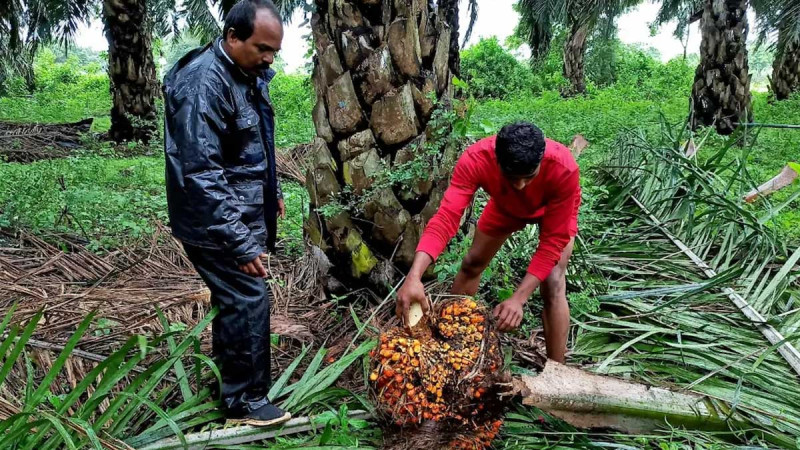
“Collectors and middlemen are becoming reluctant to move trucks to pick up farmers’ fruit from plantations. The fruit is left uncollected, rots in place, and ultimately loses its value,” Darto said.
POPSI data showed that CPO tender prices dropped sharply from around Rp15,300/kg to Rp12,150/kg within only a few days, placing immediate pressure on FFB prices across Indonesia’s palm-growing regions.
In South Sumatra, FFB prices reportedly declined from Rp3,577/kg to Rp2,722/kg. Central Kalimantan saw prices fall from Rp3,483/kg to Rp3,163/kg, while Riau recorded a drop from Rp3,397/kg to Rp3,070/kg. Similar declines were reported in Jambi, where prices fell from Rp3,266/kg to Rp2,944/kg, and North Sumatra from Rp3,299/kg to Rp2,899/kg.
POPSI argued that the core issue lies not merely in export procedures but in the lack of regulatory clarity and implementation details.
Industry players, according to the organization, still have no certainty regarding trading mechanisms, price formation, payment systems, and risk-sharing arrangements under the proposed governance model.
Darto warned that under prolonged uncertainty, companies may limit purchases to feedstock supplied by their own corporate groups in order to reduce exposure to market risk. Such a scenario could place independent palm oil mills—those without integrated refinery or export facilities—under severe pressure.
“If independent mills start reducing purchases or even suspend operations because market risks become too high, farmers will ultimately face harvest disruptions and deeper pressure on FFB prices,” he said.
POPSI also emphasized that global palm oil trade operates through a highly complex ecosystem that cannot be reduced to a narrow discussion about export administration or alleged under-invoicing.
International trade, the group noted, involves numerous pricing and risk variables, including FOB and CIF mechanisms, shipping risks, product quality, free fatty acid (FFA) levels, and buyer claims.
Indonesia’s palm oil export ecosystem, built over decades, relies on logistics networks, storage tanks, ports, tankers, international trading hubs, and global trade financing systems. International buyers purchase Indonesian palm oil not only because of supply availability but also due to delivery reliability, commercial reputation, and long-established risk management systems.
For that reason, POPSI urged the government to focus on strengthening transparency and administrative oversight without disrupting existing market mechanisms.
The organization suggested that DSI’s role should be limited to documentation, monitoring, export data transparency, and administrative supervision, while trading and price formation should remain within an open and competitive market framework.
“If the state intervenes too deeply in trading mechanisms and price formation, the risk of market distortion and domestic price pressure will grow, and farmers will once again become the biggest victims,” Darto stressed.
POPSI further warned of potential rent-seeking practices if market access and export quotas become overly concentrated, arguing that closed market structures may create privileged groups with preferential access.
In addition to reviewing the DSI policy, POPSI urged the government to reassess Export Duty (BK) and Export Levy (PE) burdens, which it believes have already weighed heavily on both the palm oil industry and Smallholders.
The organization called on the government to cancel the policy’s implementation, involve all palm oil stakeholders in regulatory design, preserve competitive market mechanisms, and prioritize protection of Smallholders’ FFB prices.
“Palm oil is the economic backbone of millions of Indonesian families. Export governance policies must be handled carefully so they do not trigger market panic and undermine the stability of Indonesia’s palm oil industry,” Darto concluded. (T2)