
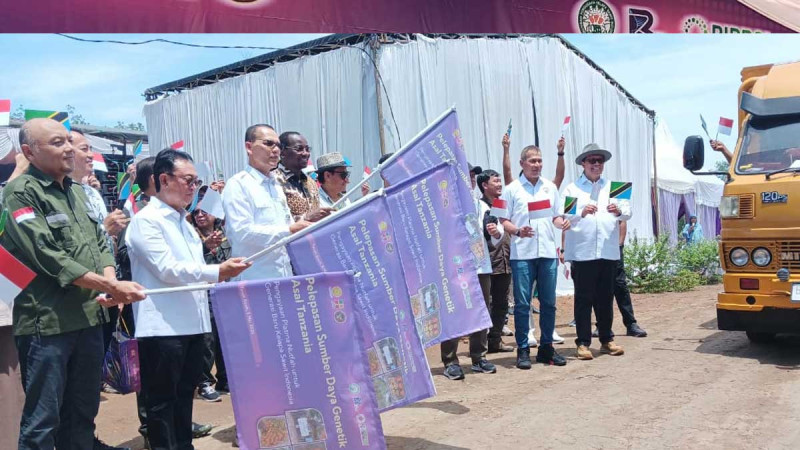
InfoSAWIT, SERDANG BEDAGAI – Indonesia has taken another strategic step to strengthen the long-term competitiveness of its palm oil industry by expanding its genetic resource base, marking the official release of oil palm germplasm sourced from Tanzania as part of the country’s national plasma germplasm enrichment program.
The release ceremony, themed “Release of Genetic Resources from Tanzania – Germplasm Enrichment for Indonesia’s Next Generation of Oil Palm”, was held at Tanah Besih Estate in Tebing Syahbandar, Serdang Bedagai, North Sumatra, on Tuesday (May 5, 2026).
The initiative was organized by GAPKI in collaboration with PT Riset Perkebunan Nusantara and PT Socfin Indonesia, as part of a research initiative led by the Directorate General of Estates aimed at exploring and broadening oil palm genetic diversity through international germplasm sourcing. The program also received financial support from BPDP.
Industry stakeholders view the introduction of Tanzanian genetic resources as a significant milestone in widening Indonesia’s oil palm germplasm pool—an essential foundation for developing future varieties that are more productive, climate-resilient, and better equipped to withstand pests, diseases, and environmental stress.
Chairman of GAPKI, Eddy Martono, described the initiative as a long-term investment in the future of Indonesia’s palm oil sector.
“With the arrival of new genetic resources from Tanzania, we are opening major opportunities to further enrich our genetic diversity. Today, we are not merely distributing germplasm—we are shaping a new future for Indonesia’s palm oil productivity,” Eddy said in an official statement received by InfoSAWIT on Thursday (May 7, 2026).
He emphasized that closer collaboration among government institutions, industry players, research bodies, and international partners is crucial to accelerating the development of superior oil palm varieties while reinforcing Indonesia’s position as the world’s leading palm oil producer built on innovation.
“We see collaboration between government, industry, research institutions, and international partners as vital. This germplasm distribution is not simply a technical exercise—it is part of a broader collective effort to strengthen Indonesia’s global palm oil competitiveness,” he added.
From a biosecurity perspective, Aprida Cristin, representing the head of Indonesian Quarantine Agency, stressed that the imported oil palm seeds underwent stringent phytosanitary screening before entering the country.
She explained that prior to receiving ministerial approval, the Tanzanian seeds underwent a comprehensive pest risk assessment, followed by multiple quarantine stages including inspection, isolation, observation, and eventual clearance.
“This extensive process reflects the precautionary principle that underpins quarantine policy, aimed at preventing the entry and spread of quarantine plant pests while safeguarding Indonesia’s biological commodities and preserving national genetic resources,” Aprida said.
Meanwhile, Mohammad Alfansyah, representing BPDP’s president director, reaffirmed the agency’s commitment to financing strategic research initiatives that directly support the long-term strengthening of Indonesia’s palm oil industry.
As host of the event, Erikson Ginting noted that the newly released Tanzanian genetic material could become a new catalyst for breeding more competitive oil palm varieties.
The event was attended by representatives from GAPKI, BPDP, the Directorate General of Estates, the Indonesian Quarantine Agency, Tanzanian Ambassador to Indonesia Macocha Moshe Tembele, the North Sumatra Center for Animal, Fish and Plant Quarantine, and 14 corporate partners involved in Indonesia’s oil palm germplasm consortium.
With this latest enrichment program, Indonesia is expected to further strengthen the genetic foundation of its oil palm industry while reinforcing its global leadership in sustainable, innovation-driven palm oil production. (T2)