InfoSAWIT, JAKARTA – The Indonesian government is further reinforcing the strategic role of the palm oil industry as one of the key drivers of the country’s downstream industrialization agenda. In the groundbreaking ceremony for 13 National Downstreaming Projects Phase II, valued at Rp116 trillion, the palm oil sector secured a prominent position through the development of a palm oil processing facility for oleofood and biodiesel in Sei Mangkei, North Sumatra, a project expected to strengthen the palm oil value chain from upstream plantations to downstream manufacturing.
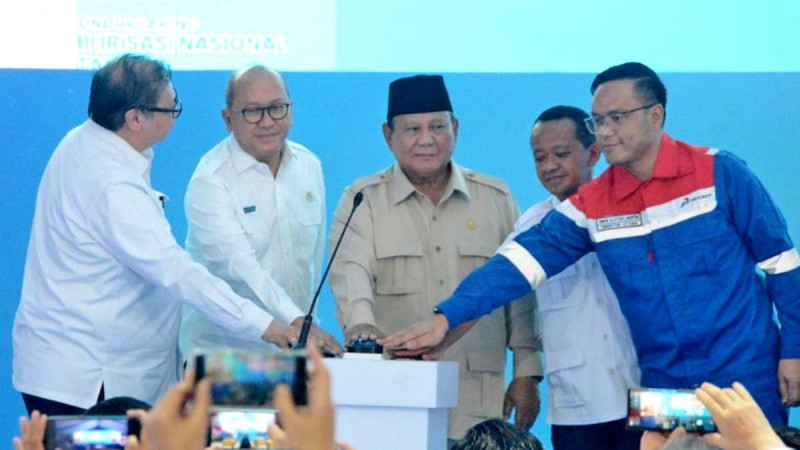
The strategic projects were officially launched by Prabowo Subianto in Cilacap on Wednesday (April 29, 2026), as part of Indonesia’s broader national economic transformation agenda centered on domestic processing of natural resources. Among the wide range of cross-sector industrial projects unveiled, palm oil downstreaming is viewed as one of the most tangible steps toward elevating one of Indonesia’s flagship commodities into a high-value-added industrial sector.
President Prabowo stressed that downstreaming is no longer merely a policy option, but rather the cornerstone of stronger, more independent, and sustainable economic growth.
“Downstreaming is the only path for us to become more prosperous,” Prabowo Subianto emphasized in an official statement reviewed by InfoSAWIT on Monday (May 4, 2026).
For the palm oil industry, the statement sends a clear signal that government policy is no longer focused solely on crude palm oil (CPO) production, but is shifting toward the development of high-value downstream products, including oleofood, bioenergy, oleochemicals, food industry ingredients, and renewable energy feedstocks.
The inclusion of the Sei Mangkei palm oil processing project in Indonesia’s national strategic project list positions the industrial estate as a major hub for the country’s palm oil downstream sector. The development of oleofood facilities opens new opportunities for palm oil diversification into higher-value processed food products, while biodiesel expansion further strengthens palm oil’s role as a backbone of national energy security through fossil fuel substitution programs.
This move also reinforces palm oil’s evolving role—not merely as a raw export commodity, but as a foundation for new industrial growth capable of creating jobs, expanding downstream investment, and increasing national revenue through domestic value-added processing.
Behind the acceleration of downstreaming, the government has positioned Badan Pengelola Investasi Daya Anagata Nusantara, or Danantara, as a new strategic instrument. Unlike conventional sovereign wealth funds (SWFs) that typically function as passive investment portfolio managers, Danantara is being designed as a catalyst for industrialization directly integrated with Indonesia’s downstream development agenda.
Danantara CEO and Minister of Investment and Downstreaming, Rosan Roeslani, described the initiative as a major leap forward in how Indonesia manages state wealth.
“This marks the beginning of Indonesia’s big leap—not only as a nation rich in natural resources, but as one that is sovereign in processing them, competitive in production, and prosperous in the outcomes,” said Rosan Roeslani.
In the palm oil context, this strategy could significantly accelerate downstream industrial development, which has long been dominated by raw commodity exports. With strong strategic financing support, Indonesia’s palm oil downstream ecosystem is expected to move more aggressively into green energy production, processed foods, pharmaceutical ingredients, cosmetics, and biomaterial-based products.
Among the 13 Phase II downstreaming projects launched, palm oil stands alongside other strategic sectors including gas processing, DME, nickel, copper, steel, and integrated coconut industries—underscoring palm oil’s continuing role as one of the key pillars of Indonesia’s economic transformation. (T2)