InfoSAWIT, JAKARTA – Gabungan Pengusaha Kelapa Sawit Indonesia has reaffirmed that Indonesia’s palm oil industry remains one of the country’s most strategic economic pillars, playing a critical role in regional development, employment generation, renewable energy supply, and long-term national economic resilience.
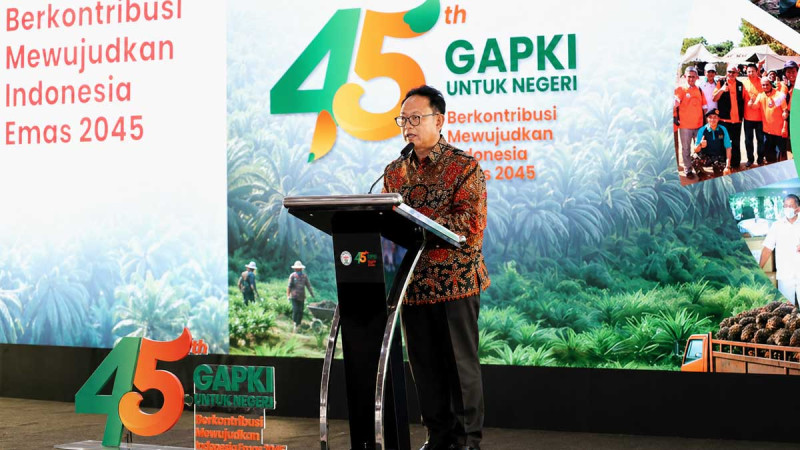
Speaking during the launch of 45 Tahun GAPKI untuk Negeri (45 Years of GAPKI for the Nation) as part of GAPKI’s 45th anniversary celebration, Eddy Martono said the industry’s decades-long development has demonstrated its broad and enduring contribution—not only to businesses, but also to government revenues, rural communities, and sustainable national development.
“The palm oil industry has made a tangible contribution to national development—creating jobs, improving the welfare of Smallholders, and strengthening Indonesia’s economic standing, including during periods of global crisis,” Eddy said in remarks delivered at the anniversary gathering attended by InfoSAWIT on April 29, 2026.
He added that despite ongoing challenges in global trade—including shifting import policies in key destination markets, rising logistics costs, and increasingly complex international competition—Indonesia’s palm oil sector remains fundamentally strong.
According to Eddy, deeper downstream industrialization, stronger domestic market development, and wider adoption of technology will be key factors in preserving Indonesia’s global competitiveness in palm oil.
“Policy certainty, investment support, and technology adoption are essential foundations to ensure Indonesia’s palm oil industry continues to grow and contributes meaningfully toward realizing Indonesia Emas 2045,” ungkap manajemen dalam laporan tersebut.
Eddy also paid tribute to GAPKI’s earlier leadership, including Joko Supriyono, as well as the authors behind the organization’s newly launched commemorative book, describing the publication as more than historical documentation.
According to him, the book serves as a reflection of the palm oil industry’s long-standing commitment to building Indonesia’s economic strength through consistent productivity gains, strategic collaboration, and sustainable industry development.
He emphasized that the industry’s success today is rooted in continuity of leadership, constructive engagement between the private sector and government, and support from institutions such as the Directorate General of Plantations, research bodies, and related associations that continue to strengthen productivity and sustainability standards.
GAPKI also highlighted the strategic importance of research and development in superior planting material, conservation efforts, and the protection of oil palm genetic resources—all of which are seen as critical for improving long-term national productivity.
Looking ahead, the association remains optimistic that Indonesian palm oil will continue to expand its strategic role—not only as a major foreign exchange earner, but also as a renewable energy feedstock, a core raw material for oleochemical industries, and a people-centered economic engine involving millions of Smallholders and workers across the country.
Together, those pillars are expected to keep palm oil at the center of Indonesia’s industrial and energy transformation as the country advances toward its Indonesia Emas 2045 vision. (T2)