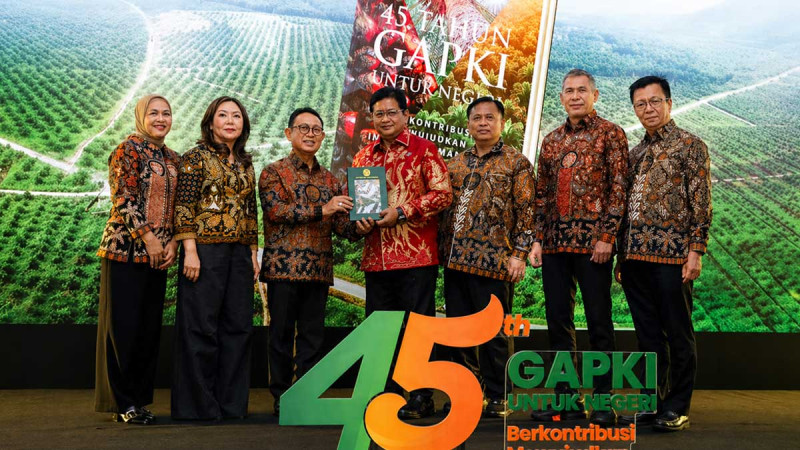
InfoSAWIT, JAKARTA – Gabungan Pengusaha Kelapa Sawit Indonesia (GAPKI) marked its 45th anniversary with a commemorative gathering and the launch of a new publication titled 45 Tahun GAPKI untuk Negeri (45 Years of GAPKI for the Nation), underscoring the palm oil industry’s long-term contribution to Indonesia’s economic growth, employment generation, and energy security.
Held at Pullman Jakarta Indonesia in Central Jakarta on April 29, 2026, the event highlighted GAPKI’s four-decade journey as one of the country’s most influential industry organizations, actively shaping policy dialogue and supporting the expansion of Indonesia’s palm oil sector into a globally strategic commodity industry.
Eddy Martono, Chairman of GAPKI, said the organization’s 45th anniversary was more than a milestone in age—it was a moment of reflection on decades of industry transformation, institutional learning, and increasingly close strategic collaboration between government and the private sector.
“This 45-year milestone is not merely about age. It reflects a long journey filled with dynamics, challenges, and lessons learned, while reinforcing GAPKI’s position as a strategic partner to the government,” Eddy said at the event attended by InfoSAWIT.
He noted that palm oil’s contribution to the national economy extends well beyond export earnings, emphasizing its role in creating millions of jobs, improving rural welfare, and accelerating development in producing regions across Indonesia.
“The palm oil industry has become one of the pillars of the national economy—creating millions of jobs and driving regional development, particularly in producing areas,” he added.
Book Captures Palm Oil’s Industrial Journey
The launch of 45 Years of GAPKI for the Nation became one of the central highlights of the celebration. The book documents GAPKI’s institutional history and its role in helping build a stronger, more resilient, and increasingly sustainable palm oil industry.
More broadly, the publication also reflects the transformation of palm oil into one of Indonesia’s leading economic engines—serving as a major foreign exchange earner while supporting the livelihoods of millions of people directly and indirectly connected to the industry.
The anniversary event also featured a documentary screening on GAPKI’s journey, a presentation from the book’s writing team, a symbolic handover of the publication, and a ceremonial rice cone cutting—an Indonesian expression of gratitude and celebration.
The gathering drew senior government officials, diplomats, industry leaders, Smallholder associations, and stakeholders from across the palm oil ecosystem, reflecting the sector’s broad national and international significance.
Government Recognition for Industry Contribution
Representing Indonesia’s Ministry of Industry, Putu Juli Ardika praised GAPKI’s contribution to national industrial development, particularly its efforts to preserve institutional memory and document the evolution of one of Indonesia’s most strategic sectors.
“We extend our appreciation and gratitude for GAPKI’s contribution, including the launch of this book, which provides a legacy and valuable reference for all of us,” Putu said.
Over the past 45 years, GAPKI has evolved from a business association into a strategic policy partner in a wide range of initiatives—from non-oil export expansion and Smallholder replanting programs to sustainability implementation and biodiesel development as part of Indonesia’s national energy transition agenda.
The organization has also expanded its role in economic diplomacy and strategic communication globally, helping strengthen Indonesia’s position in increasingly complex international palm oil markets.
Looking ahead, GAPKI reiterated its commitment to improving governance, accelerating downstream industrialization, expanding research and innovation, and strengthening the role of Smallholders as an essential pillar in the industry’s long-term supply chain resilience. (T2)