InfoSAWIT, JAKARTA – The government’s policy requiring exporters to retain 50% of Export Proceeds (DHE) for one year has been promoted as a strategic move to safeguard foreign exchange reserves and stabilize the rupiah. On paper, the logic appears sound.
Yet on the ground, the policy risks widening the gap between macroeconomic stability goals and the realities of the real sector—particularly the palm oil industry, which remains a backbone for regional economies across Indonesia.
The problem is not the goal of the DHE policy itself, but its timing and implementation. Palm oil is not an industry that can afford to wait. Cash flows move quickly, margins are relatively thin, and the entire supply chain depends on smooth liquidity. More importantly, palm oil is not only about exporters and large corporations—it is a vast ecosystem that involves workers, fruit suppliers, intermediaries, mills, and millions of smallholders.
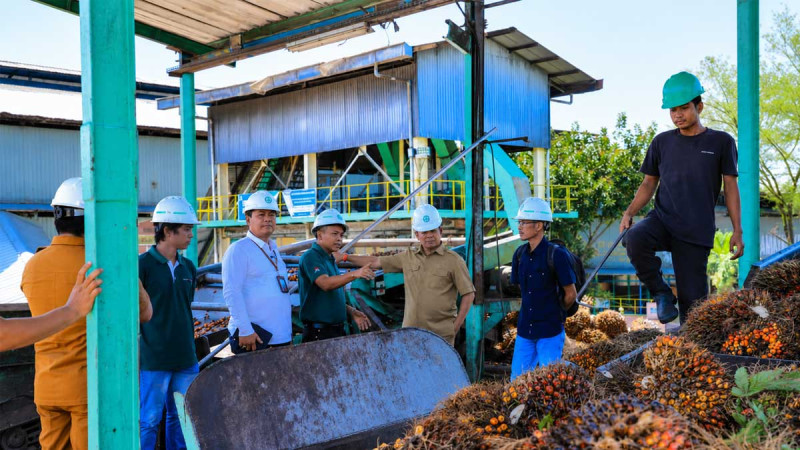
When half of export earnings are effectively “locked” for a year, exporters face tighter working capital. In practice, this means palm oil exporters may have cash from global transactions, but cannot freely use it to finance day-to-day operations—buying CPO, paying Fresh Fruit Bunches (FFB), covering labor costs, purchasing farm inputs, or supporting replanting programs.
Under such pressure, exporters have limited options. To stay afloat, they may push down CPO purchase prices from mills, reduce purchasing volumes, or—under the worst-case scenario—stop providing advance payments to suppliers. The pressure will not stop in corporate boardrooms. It will cascade downward, hitting the most vulnerable layers of the supply chain.
Palm fruit processing mills, forced to keep operating under high cost burdens, may respond by lowering FFB buying prices from suppliers and smallholders. Fruit collectors risk delayed payments from mills, and ultimately squeeze farmgate prices in rural communities. This chain almost always ends at the lowest point: independent smallholders—estimated at around 3.5 million people—who have the least bargaining power and the weakest protection.
Historically, smallholders have repeatedly borne the costs of policy shifts, yet remain among the least protected actors in the industry.
Beyond the immediate impact, the DHE policy reflects a mindset that views exporters’ foreign exchange earnings as an obligation to be controlled, rather than an incentive-based instrument. Compliance is shaped through restrictions and potential sanctions, without meaningful compensation for the burden imposed—particularly on small players at the grassroots level.
The real concern is that policymakers may not fully anticipate how the risks unfold at village level, even as smallholders and workers are often described as key subjects of national development. When policies operate through coercion, the outcome is predictable: pressure is passed down to those who are weakest—palm oil smallholders.
It is also important to acknowledge that this policy does not exist in isolation. The palm oil sector is already carrying multiple layers of burden. Planned increases in export levies, legal uncertainty over plantations classified as forest areas, land seizures, forced relocations, and the looming threat of fines—reportedly reaching Rp 25 million per hectare—are adding further strain. For many smallholders, such figures are far beyond their economic capacity.
Meanwhile, mills facing supply shortages also risk operational disruptions, and in extreme cases, closure.
For those on the ground, these are not simply “new regulations” that can be adjusted gradually. They are direct pressures on the survival of the palm oil ecosystem.
Yet in villages, smallholders continue to do what they always do: harvest, fertilize, maintain their farms—often without knowing whether tomorrow’s FFB prices will fall again, or whether their market access will shrink further.
Smallholders have limited room to negotiate. FFB cannot be stored for long. Harvest schedules cannot be postponed. And most smallholders depend on a single commodity for their livelihood. When prices are pushed down from every direction, their only option is to accept.
This is where the policy irony emerges. A macroeconomic policy executed in the name of stability may end up undermining the livelihoods of millions of palm oil smallholders across Indonesia.
Foreign exchange stabilization should not be pursued through coercive measures that weaken productive sectors. If the government insists on implementing the DHE policy, it must be aligned with cross-sector policies and backed by concrete compensation mechanisms. At the very least, the retention ratio should be more tolerable—holding 50% for a year is simply not reasonable for an industry heavily dependent on cash flow.
Without policy harmonization and compensation, the DHE regulation will only push more burdens down the supply chain—ultimately landing on smallholders, who are the true backbone of palm oil exports and rural economic growth.
At the end of the day, the question remains: should macro stability be prioritized to the extent that it is paid for by squeezing productive sectors and smallholders who have already carried so much? (*)
Disclaimer: This article reflects the author’s personal views and is fully the author’s responsibility. It does not represent InfoSAWIT’s position.