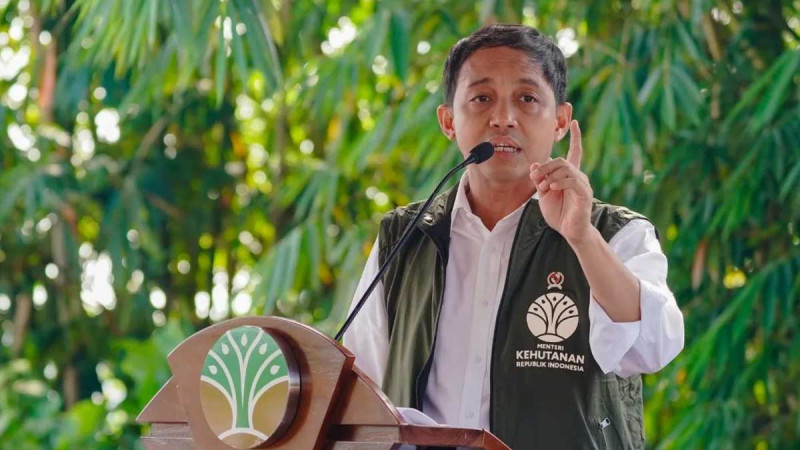
InfoSAWIT, JAKARTA – The government continues to enforce the removal of illegal palm oil plantations in conservation areas, but these efforts are fraught with various challenges on the ground. Minister of Forestry Raja Juli Antoni revealed that some plantation companies disguise their activities by using community names, especially in conservation areas like Tesso Nilo National Park (TNTN) in Riau.
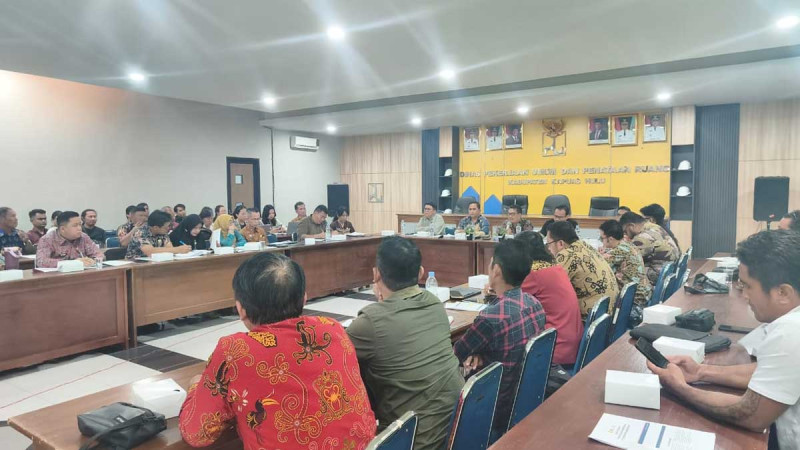
During a working meeting with Commission IV of the Indonesian House of Representatives in Jakarta last Tuesday, the Minister emphasized that the Forest Area Enforcement Task Force (Satgas PKH), which also involves the Ministry of Forestry, continues to verify and inventory the use of forest areas, including illegal palm oil plantations.
“The technical problems are not easy on the ground, as there are models where these corporations also have ways to use community names,” he stated before the members of the council, as reported by InfoSAWIT from Antara on Friday (July 11, 2025).
He explained that there are covert practices where palm oil plantations are managed by corporations but registered or operated under the names of residents. This modus operandi complicates the enforcement process, as it appears that the land is managed by smallholders, while in reality, it is controlled by large companies.
“This verification is not easy, and that is also what happens in Tesso Nilo. Data from the police involved in the task force shows that many lands are actually owned by corporations, but in the field, they are under the guise of community management,” said the Minister.
Furthermore, he explained that the plantation workers whose names are used often serve as a shield for corporate activities. The palm oil from these plantations is then sold to companies, even when these activities are conducted in conservation areas that should be free from economic activities.
In addressing this complex situation, the government is prioritizing a soft power approach to prevent social conflicts. One of the strategies is to prepare a relocation scheme for communities willing to voluntarily leave conservation areas.
“For the affected communities, it is hoped that they will carry out self-relocation, but the government has also prepared relocation land,” he explained.
This relocation land is being prepared by the Post-Occupation Recovery Acceleration Team (TP4) for Tesso Nilo National Park, established by the Governor of Riau. This team is mandated to formulate a relocation plan, provide replacement land, design social assistance schemes, and execute relocations based on mutual agreements.
Meanwhile, the process of restoring the functions of conservation areas continues. Raja Juli reported that several parties have voluntarily surrendered their illegal palm oil plantations to the state. The government has even destroyed illegal plantations at several locations.
“Destruction of illegal palm oil plantations covering 401 hectares was carried out on June 29, 2025, and 311 hectares on July 2, 2025,” he stated.
These measures are part of the government's broader agenda to restore the functions of conservation areas, improve forest governance, and regulate non-compliant plantation practices. The government hopes that with accurate verification and a collaborative approach, agrarian conflicts in conservation areas like Tesso Nilo can be resolved without infringing on community rights or compromising environmental sustainability.
“This effort cannot be completed overnight, but we ensure that this process is ongoing. National Parks are not places for palm oil, and the law must be enforced without exception,” Raja Juli concluded. (T2)