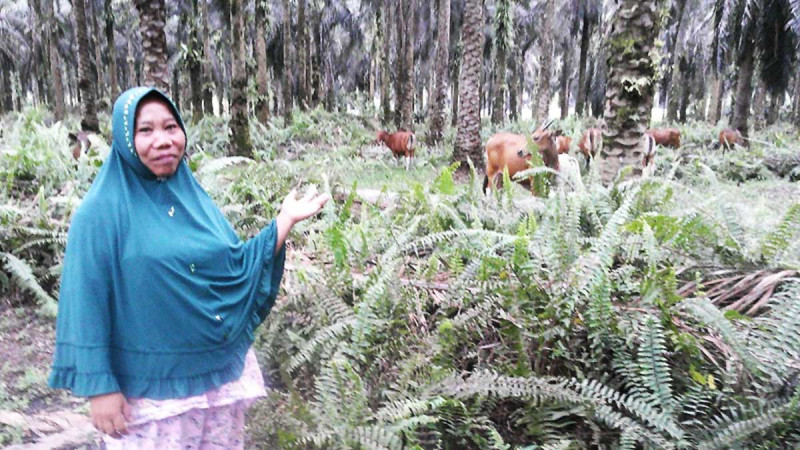
InfoSAWIT, JAKARTA - In a different narrative, Suratmi, a 45-year-old woman, often leads her cattle from her home to the palm oil fields managed by Agrinas. On a misty morning in Dusun Muda, Desa Pamesi, Batin Solapan, she gently guides her cows without a whistle or stick, a routine she has mastered over the years.
"I let them out in the morning and tie them up in the evening," she smiles, referring to her practice of tethering her cows at night. Once owning 32 cows, she now has 25, having sold some for the Eid al-Adha celebrations. Without a large barn, her cows roam freely in the palm oil fields, where the grass grows abundantly, providing natural feed, while their waste serves as fertilizer. "It's easier this way. If I kept them in a barn all the time, it would complicate my other work," she adds.
Interestingly, the land where Suratmi's cows graze is not just any field; it is state-owned land now managed by a local cooperative in partnership with PT Agrinas Palma Nusantara (Persero), a state-owned enterprise transformed from PT Indra Karya (Persero). This land was previously embroiled in legal issues and is now under the supervision of the Attorney General's Office. Agrinas has been entrusted with restoring the economic value of this land—not only through palm oil production but also through community empowerment.
"If possible, all the potential of this land should be utilized for the benefit of the people. Livestock, agriculture, everything can coexist," said a representative from Agrinas during a visit to the site.
In the midst of the palm oil fields, Suratmi finds a space to live. She does not need to buy feed or clean a barn. "The cows are full, and the palm oil grows. They help each other," she said, as reported by InfoSAWIT.
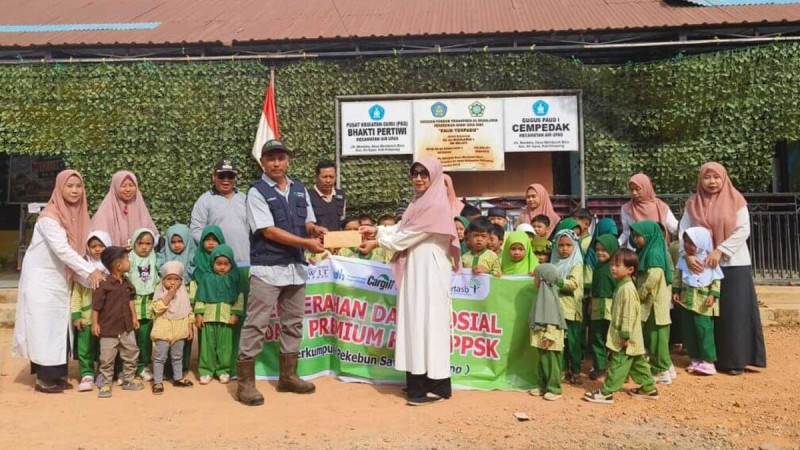
In mid-June, PT Agrinas Palma Nusantara provided livestock assistance to several farmer groups. Suratmi, however, did not receive any, not because she didn't need it, but because she was unsure where to inquire. "I wanted to ask, but they said it was only for farmer groups," she said softly. "I'm not part of a group. My husband only works night shifts, not as a harvester."
She does not appear disappointed, only hopeful. Just two or three additional cows would suffice to boost her livelihood. "If possible, I would raise them. What matters is having something to do," she expressed.
Suratmi is aware that the land she grazes on was once controlled by a few individuals. Now, it is open to many residents. She believes that if the state intervenes through companies like Agrinas, justice should also reach small farmers like her.
As dusk approaches, the cows return on their own. Suratmi welcomes them beneath the palm trees, patiently guiding them one by one with a rope in hand. Life for her is like herding cows—calm yet continuously moving forward.
She is not alone; many residents around the palm oil fields share similar hopes tied to PT Agrinas Palma Nusantara. Hopes for land that provides opportunities, not just for palm trees but also for the people living nearby. Agrinas Palma Nusantara is not merely managing state assets; in the eyes of the community, the company serves as a bridge between land and future. Amidst the rows of palm trees and cattle, hope gradually grows—guided by the simple hands of individuals like Suratmi. (T2)