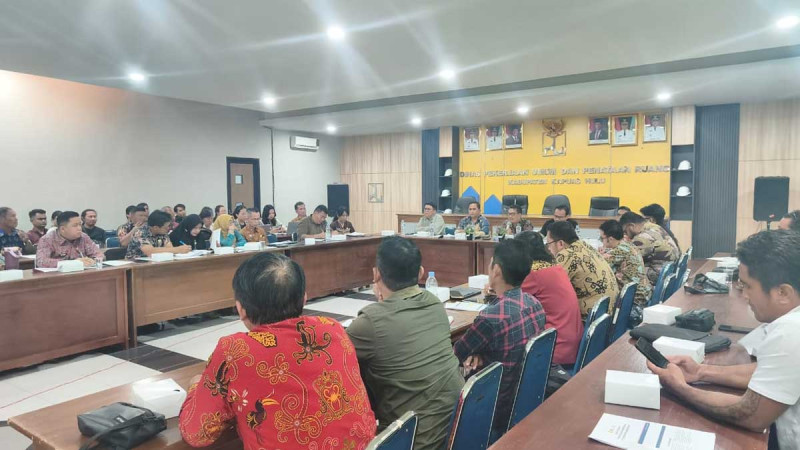
InfoSAWIT, JAKARTA - In a recent mediation session held at the BPU Office in Kembang Janggut Village on Thursday, July 3, 2025, the ongoing land conflict between local palm oil farmers and PT Rencana Mulia Baratama (RMB) reached an impasse. The mediation did not produce any fruitful outcomes, as the farmers firmly rejected the company's compensation offer of IDR 25 million per hectare.
For the farmers, this amount is not only deemed inadequate but also disrespectful to their years of hard work in cultivating palm oil plantations from scratch. "Imagine, the palm oil that gives me IDR 5 million every month is being offered at IDR 25 million for eternity. This is not just unreasonable; it is an insult to my life," asserted Stepanus, one of the farmers present at the mediation, accompanied by Lahuddin from the Belayan Palm Farmers Forum (FPSB), who voiced the farmers' frustrations and anger towards the company's stance.
According to Stepanus, his plantation can produce up to 2 tons of fresh fruit bunches (TBS) per hectare each month, which has been the backbone of his family's livelihood. "I planted and cared for this palm oil myself. This is not just a field; it is our hope for survival," he stated.
Lahuddin also expressed his discontent, labeling the company's offer as a sign of insensitivity to the realities faced by farmers. "With such a value, they are belittling all the hard work of farmers. This is not just about land compensation—it's about dignity, about justice. This is a matter of human rights," he emphasized.
During the meeting, PT RMB representatives stated that they would take the mediation results for internal discussion, requesting one week to respond to the farmers' input before making any further decisions. Meanwhile, the Kembang Janggut sub-district head, who led the mediation, set a one-week deadline for the company to present a more equitable and just decision. If no progress is made, the conflict will be escalated to the Kutai Kartanegara district level for further handling.
In a separate statement, FPSB Chairman Jamaluddin expressed deep disappointment with PT RMB's approach. Although he was unable to attend due to commitments in Kutai Timur, he criticized the company's strategy as exacerbating the situation. "A few months ago, they came to Muai Village and offered land compensation of only IDR 5 million per hectare. That alone made us angry. Now, IDR 25 million is still far from adequate," he remarked. "We told them to learn about Pancasila again. Offers like this lack a sense of justice and humanity."
Jamaluddin also criticized the company's overly legalistic perspective, which he believes overlooks social aspects. "We do not need pity. We need justice," he stated. The FPSB emphasized that this issue is not merely about compensation amounts. For the farmers, palm oil represents the foundation of their lives, their future savings, and a symbol of independence amid the lack of state attention.
"If our palm oil is considered wrong, where has the state been all this time?" questioned Lahuddin. "When we opened the land, there was no assistance. But when our palm oil bears fruit, we are suddenly deemed to be violating the law."
The mediation, which lasted from 10:30 AM to 12:30 PM WITA, saw the participation of various stakeholders, including the Kembang Janggut sub-district head, the police chief, the acting head of Longbleh Modang Village, PT RMB representatives, and FPSB officials. The FPSB called for future mediations to adopt a more open, humane, and dialogue-based approach, rejecting corporate tactics that are coercive and one-sided. "Legality should not be a tool to trample on humanity," Lahuddin asserted.
Such agrarian conflicts should be viewed not merely as land disputes but as reflections of the state's failure to protect the marginalized. The palm oil plantations, now battlegrounds, hold stories of hard work, hope, and the struggles of communities that have built their lives outside the shadows of power. (T2)
Report: Jamal/East Kalimantan