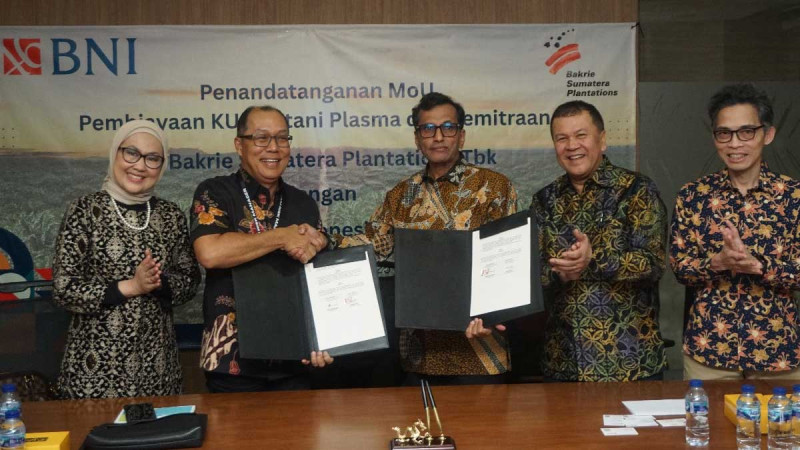
InfoSAWIT, JAKARTA – Efforts to boost productivity and welfare for smallholder palm oil farmers have received concrete support from the business and national banking sectors. PT Bakrie Sumatera Plantations Tbk (BSP) and PT Bank Negara Indonesia (Persero) Tbk (BNI) have officially signed a Memorandum of Understanding (MoU) for the financing of People's Business Credit (KUR) and strategic partnerships for plasma farmers, on Friday in Jakarta.
This collaboration not only reinforces the commitment of both parties to strengthen sustainable palm oil plantation sectors but also represents a tangible step towards enhancing the foundations of national food and energy security through support for the replanting program for smallholder palm oil.
The signing ceremony began at 4:00 PM WIB, starting with remarks from BSP's President Director, Bayu Irianto, and Vice President Director, Vinayaka B.S. From BNI, remarks were delivered by Annisa Milana, Department Head of Enterprise Banking Division, and Sunarna Eka Nugraha, Division Head of Business Program Division. Both parties also introduced their teams and outlined the KUR financing scheme to be implemented in partnership with plasma farmers.
In its presentation, BNI sees financing potential reaching Rp1 trillion to reach over 13,400 palm oil farmers involved in the plasma program under the Bakrie group, with a total land area of 19,406 hectares. This program includes five strategic entities spread across three provinces: PT Bakrie Sumatera Plantations Tbk – Kisaran, North Sumatra; PT Grahadura Leidongprima – Aek Kanopan, North Sumatra; PT Agrowiyana – Tanjung Jabung Barat, Jambi; PT Sumbertama Nusapertiwi – Muaro Jambi, Jambi; and PT Bakrie Pasaman Plantations – Pasaman, West Sumatra.
This cooperation is designed to reach more plasma farmers through structured KUR financing, accompanied by a partnership model that supports capacity building, productivity enhancement, and sustainability of smallholder palm oil farming.
“This program is not just about access to financing, but also about building a healthy partnership ecosystem between companies and farmers. The hope is that farmers' welfare improves, palm oil production becomes more optimal, and ultimately strengthens contributions to national food and energy security,” Bayu Irianto stated in an official statement to InfoSAWIT on Tuesday (June 24 , 2025).
Support for farmers does not stop at financing. BSP also promotes productivity enhancement through superior seed innovations. Currently, national palm oil productivity hovers around 3 tons of CPO per hectare per year. However, with superior seeds developed by BSP, production potential can reach up to 10 tons of CPO per hectare per year.
These superior seeds can yield up to 40 tons of palm fruit per hectare annually, with a crude palm oil (CPO) extraction rate of 25 percent—figures that have been tested in the field and are officially certified. This makes replanting not just a necessity for plant regeneration but a national strategy to double production without needing to expand land, while also increasing the supply of biodiesel feedstock.
“With superior seeds, we do not need to open new land. We just need to improve and rejuvenate existing plantations, and the results can multiply significantly. This is not only efficient but also sustainable,” Vinayaka B.S. emphasized.
This partnership program positions farmers as strategic partners in the national palm oil industry supply chain. In addition to financing and superior seeds, farmers will also receive technical and managerial assistance to ensure that all stages of cultivation and land management adhere to sustainability standards.
The event concluded with the exchange of souvenirs, a networking session, and a group photo with all participants, marking the beginning of a new synergy between the private sector and financial institutions in supporting the transformation of smallholder palm oil sectors.
The steps taken by BSP and BNI are expected to serve as a model for productive partnerships that can address future challenges, where palm oil is not only an export commodity but also a crucial pillar of national energy security through its contribution to the biodiesel program based on CPO. (T2)