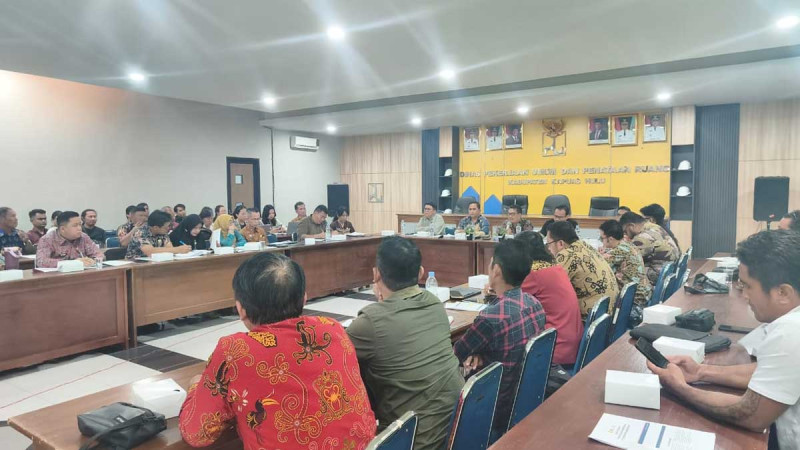
InfoSAWIT, KUALA LUMPUR — The Malaysian government is preparing to hold direct dialogue sessions with palm oil industry players following concerns over the implementation of a 5% Sales and Service Tax (SST) set to take effect next month on the oleochemical sector.
Plantation and Commodities Minister Datuk Seri Johari Abdul Ghani stated that this policy needs to be reviewed based on real input from companies directly involved in the palm oil industry supply chain, from milling and refining to oleochemical processing.
"We do not want to merely react to complaints. We want to hear directly from industry players: which sectors are affected, and how this policy impacts their competitiveness," Johari said at a press conference after launching the Malaysian Palm Oil Board (MPOB) Technology Transfer Program 2025 on Thursday.
This statement marks the ministry's open approach to industry feedback, amid reports that the tax imposition could increase input costs, particularly for the oleochemical sector, which has been a mainstay of Malaysia's exports.
"Sometimes comments come from outsiders who do not understand the intricacies of operations on the ground. Therefore, we will only assess input from those who are truly involved in the production process, from palm oil mills to oleochemicals," Johari emphasized, as reported by InfoSAWIT from The Edge Market on Saturday, June 21, 2025.
He also added that the tax does not apply to raw materials that are exported, so the perception that all palm oil commodities are now burdened with additional costs needs to be clarified.
Recent data indicates that the oleochemical sector contributes approximately 24% of the total export value of Malaysian palm oil products, equivalent to RM27.5 billion throughout 2024. Given this value, it is no surprise that industry players are wary of the potential impact of the new tax scheme.
A report from CIMB Securities warns that starting July 1, palm kernel oil and its derivatives, such as refined, bleached, and deodorized palm kernel oil, as well as palm kernel shells, will be subject to a 5% tax. All these products have been reclassified under the expanded SST framework, encompassing 4,800 HS (Harmonized System) codes.
The HS code itself is an international standard classification system for products traded across borders. This classification change automatically affects the duty and tax structure that companies must bear.
Despite rising concerns, Johari stated that no company has officially submitted a tax exemption request. However, the ministry remains open to reasonable submissions that demonstrate a significant impact on national competitiveness.
"If it is proven that there is a direct effect on the competitiveness of the Malaysian palm oil industry, we do not rule out the possibility of a review. But it must be based on evidence on the ground," Johari concluded. (T2)