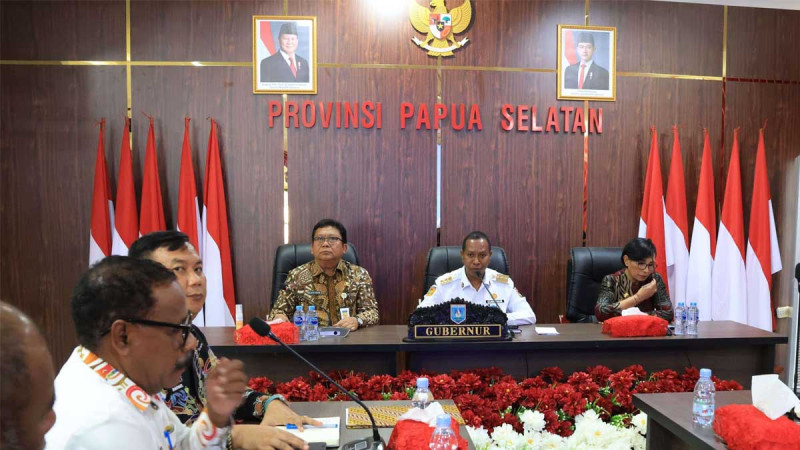
InfoSAWIT, MERAUKE — The South Papua Provincial Government officially received data and licensing documents for palm oil plantations from the Papua Provincial Government on Thursday, June 19, 2025. This handover marks a significant milestone in strengthening the governance of the plantation sector in the newly established region, while also signifying the transfer of administrative authority that has previously remained with the parent province.
South Papua Governor Apolo Safanpo stated that the data provided includes strategic information related to palm oil business activities in three districts: Merauke, Boven Digoel, and Mappi—areas with the highest concentration of palm oil plantations in South Papua.
"We express our gratitude for this data transfer. It serves as a foundation for us to begin building a better monitoring and management system for palm oil plantations, tailored to the characteristics of South Papua," Governor Apolo said, as reported by InfoSAWIT from KBRN RRI on Saturday, June 21, 2025.
The data received is part of the long-term efforts by the Papua Provincial Government in the verification and evaluation program for palm oil licensing from 2020 to 2022. During this period, licensing data was compiled, verified, and integrated into the National Strategy for Corruption Prevention (Stranas PK), as part of efforts to support a unified mapping policy in the palm oil sector.
This initiative is also driven by the mandates of Presidential Regulation No. 54 of 2018 and Presidential Instruction No. 8 of 2018, which emphasize the importance of a moratorium and evaluation of palm oil licenses, as well as sustainable productivity improvements.
With the provincial expansion of Papua in 2022, which resulted in the formation of South Papua, Central Papua, and Papua Mountains, the authority over the plantation sector—including the management of palm oil licensing data—has shifted to each new province.
Out of a total of 50 palm oil companies evaluated by the Papua Provincial Government at that time, their distribution spans across eight districts. Three of these districts are now under the administration of South Papua, while two others (Nabire and Mimika) belong to Central Papua, and the remaining three remain in the parent province of Papua.
"For South Papua, our focus will be on data management and monitoring in Merauke, Mappi, and Boven Digoel," Apolo explained.
Governor Apolo also emphasized the importance of inter-agency coordination to ensure that the data received is accurate and reflects the actual conditions on the ground. He urged the Regional Development Planning, Research, and Innovation Agency (Bapperida) and the One-Stop Investment and Integrated Services Office (DPMPTSP) of South Papua to work closely together in the subsequent validation process.
"The next step is to form a cross-agency coordination team to recheck the data in the field, ensuring there are no overlapping data or problematic licenses," he stated.
This data handover serves as a crucial foundation for South Papua in building a transparent, evidence-based, and sustainable governance system for the palm oil sector. Amid national and international scrutiny of palm oil industry practices, this initial step is expected to strengthen South Papua's position in addressing governance issues that have historically been prone to conflict and licensing irregularities.
With official data from the evaluation and verification process in hand, local governments now have a legal and administrative basis to reorganize problematic licenses and encourage palm oil companies to operate in accordance with sustainability principles and regulatory compliance.
"This data is not just numbers; it is the foundation for the future governance of palm oil in South Papua. With cross-agency synergy, we can build a fair, productive, and responsible plantation sector," concluded Governor Apolo. (T2)