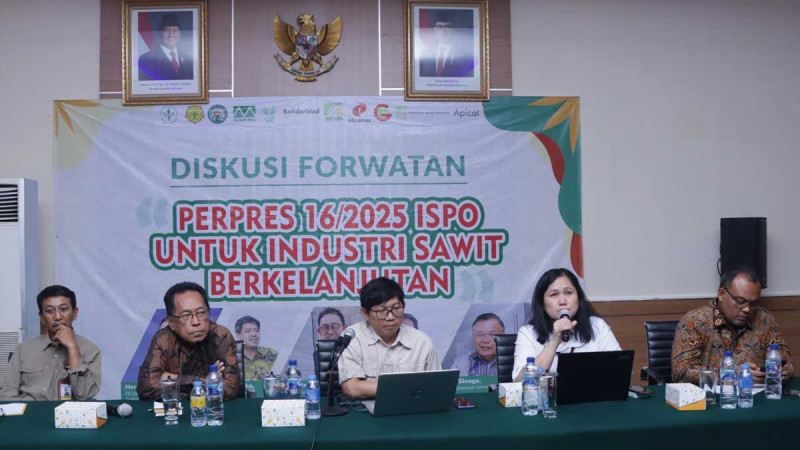
InfoSAWIT, JAKARTA – The Indonesian Palm Oil Entrepreneurs Association (GAPKI) has proposed the establishment of a Daily Executive for the ISPO Committee to strengthen the technical and administrative implementation of the Indonesian Sustainable Palm Oil (ISPO) certification, which is currently deemed suboptimal. This proposal was presented by GAPKI's Plantation Sector Chairman, R. Azis Hidayat, during a discussion at the Agricultural Journalists Forum (Forwatan) attended by InfoSAWIT in Jakarta on Wednesday (June 4, 2025).
According to Azis, the new structure of the ISPO Committee—where the Coordinating Minister for Economic Affairs serves as the Chair—lacks a Steering Committee as it did previously, complicating coordination at the technical implementation level. "With a Daily Executive in place, administrative and technical tasks can be more effectively managed on a daily basis. This will help accelerate the achievement of ISPO certification," Azis stated.
ISPO Certification Still Low
Data from the Directorate General of Plantations indicates that only about 100,000 hectares of smallholder plantations are ISPO certified, out of a total of approximately 6.94 million hectares. Land legality issues remain a significant barrier, as many farmers lack ownership certificates (SHM) or cultivation registration certificates (STDB). "Out of nearly 7 million hectares, only about 980,000 hectares have complete documentation. What about the rest? This is a serious issue," he remarked.
A similar situation exists among large companies, many of which have yet to obtain Business Use Rights (HGU), a key requirement for ISPO certification. "Many companies are still in the process of finalizing their HGU. This poses a serious threat to their ISPO eligibility," Azis added.
Despite these challenges, GAPKI remains committed to achieving a 100% ISPO certification target. As of June, out of 1,177 GAPKI members, 687 companies, or about 58%, have obtained ISPO certification, covering an area of 3.6 million hectares.
As a demonstration of commitment, GAPKI has established a special division to handle ISPO and partnerships with farmers. The organization is also implementing various initiatives such as ISPO Clinics in 15 provinces, auditor training, and educational and advocacy activities for ISPO at national and international forums, including the Indonesia Palm Oil Conference (IPOC) in Bali. "GAPKI positions itself as a strategic partner to the government. If there are ineffective policies on the ground, we provide constructive feedback," Azis asserted.
Solidaridad Supports Certification for Smallholder Farmers
From the civil society perspective, the organization Solidaridad Indonesia has also expressed similar concerns. Edy Dwi Hartono, Head of Program Development at Solidaridad, noted that only about 1% of the total 2.5 million smallholder palm oil farmers have achieved ISPO certification. "This is a significant task to ensure that smallholder farmers are not sidelined in the future palm oil industry," Edy stated.
Through its Reclaim Sustainability program, Solidaridad has trained nearly 25,000 farmers since 2019 and successfully mapped over 6,900 plots of land totaling nearly 9,000 hectares. Of this, more than 4,800 STDB documents have been issued. However, only 220 supported farmers have achieved ISPO certification. In comparison, 1,023 farmers have obtained Roundtable on Sustainable Palm Oil (RSPO) certification, and 2,463 others are certified under Regen Agri.
Solidaridad also supports the implementation of Presidential Regulation No. 16 of 2025 through multi-stakeholder collaboration and strengthening farmer institutions. In West Kalimantan, Solidaridad collaborates with the Keling Kumang Credit Union Cooperative and several farmer associations, including the Palm Oil Farmers Union (SPKS). "We are involved in institutional strengthening, training, land mapping, and focus group discussions (FGDs) and field schools in various regions," Edy explained.
However, in terms of funding for certification processes such as audits, Solidaridad has not yet been able to provide full support. They hope for intervention from the Palm Oil Plantation Fund Management Agency (BPDPKS). Solidaridad is also actively involved in policy advocacy forums, including the Recruitability initiative, which brings together various stakeholders, such as representatives from the Directorate General of Plantations and BPDPKS, to expedite the implementation of ISPO certification on the ground. "Understanding of ISPO at the national level is quite good. However, there is still a significant gap at the regional level," Edy concluded. (T2)