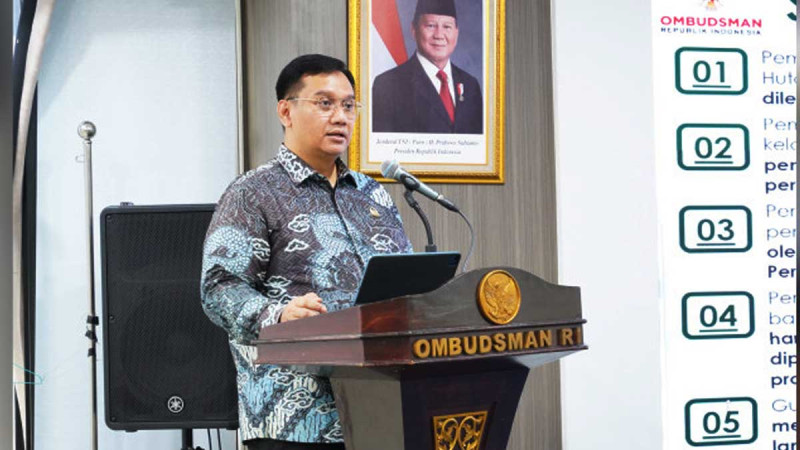
InfoSAWIT, PALANGKA RAYA – Amid the complexities of national palm oil governance, a proposal has emerged from Palangka Raya: the establishment of a National Palm Oil Agency. This suggestion, put forth by Indonesian Ombudsman member Yeka Hendra Fatika, is not merely a casual idea. It carries a grand vision—one of an Indonesian palm oil industry that is well-managed, efficient, and profitable, potentially generating hundreds of trillions of rupiah for the country.
“If managed accountably and comprehensively, the existence of a National Palm Oil Agency could contribute an additional revenue of up to Rp 650 trillion,” Yeka stated, as quoted by InfoSAWIT from Antara, Monday (June 2, 2025).
This enticing figure is not arbitrary. According to Yeka, the potential stems from increased productivity of smallholder plantations, higher export prices for crude palm oil (CPO) due to the resolution of deforestation issues, and additional taxes from the palm oil sector. In comparison, the current contribution of palm oil stands at Rp 88 trillion in 2023, comprising Rp 50.2 trillion in taxes, Rp 32.4 trillion in non-tax state revenue (PNBP), and Rp 6.1 trillion in export duties.
However, managing such a vast industry is not as simple as flipping a coin. Currently, palm oil policies are scattered across various ministries—from Agriculture, Industry, Forestry, to ATR/BPN. According to Yeka, this is the source of confusion. Thus, the proposal for a new agency directly under the President becomes logical and urgent.
“Malaysia has long had the Malaysia Palm Oil Board (MPOB) that regulates their industry in an integrated manner. Their palm oil area is much smaller than ours, yet their TBS prices are more stable and higher,” he noted.
The fundamental issue facing Indonesia, Yeka clarified, lies at the production root: the productivity of smallholder palm oil, which is only 8–10 tons per hectare, while the potential could reach 20 tons. The main cause: poor-quality seeds. It is estimated that 70% of farmers use uncertified seeds. The solution lies in replanting programs, but this initiative has stalled despite available funding from BPDPKS.
“Of the potential 6 million hectares of smallholder plantations, only about 100,000 hectares are replanted each year. This is far from sufficient,” Yeka stated.
Moreover, there is the issue of land overlaps between palm oil plantations and forest areas. This problem is not just a domestic concern. In the global market, it results in lower prices for Indonesian CPO and difficulties in obtaining sustainability certifications like RSPO. Our palm oil products become ‘cheap’ not due to quality, but because of chaotic governance.
To address this, the government has formed a Forest Area Enforcement Task Force (PKH). Although criticized for its militaristic approach due to the involvement of the military, police, and prosecutors, Yeka sees this as a new approach that could bring hope.
“If only civilians manage palm oil, the problems will never be resolved. With the military involved, it could indicate a serious intent to clean up palm oil governance from the roots,” Yeka concluded. (T2)