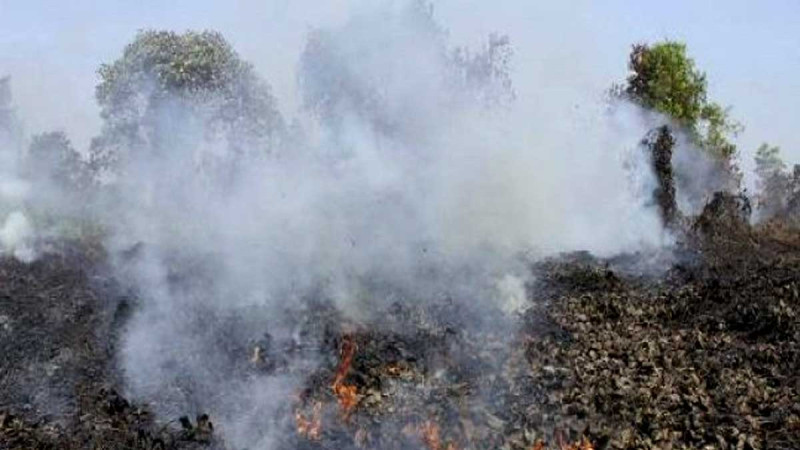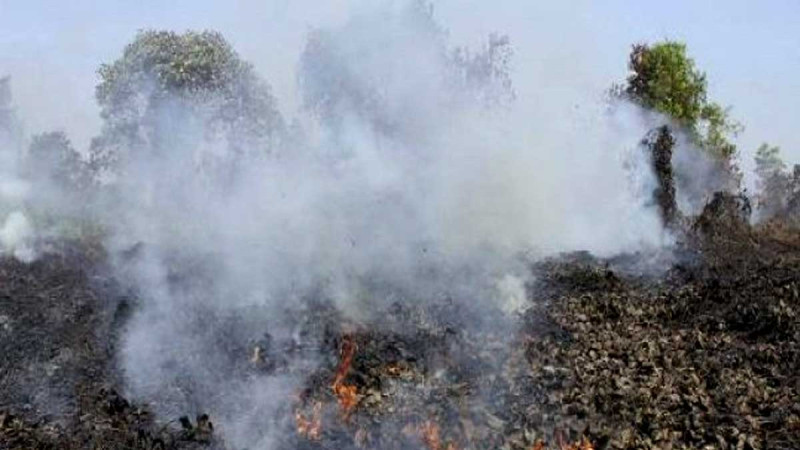
InfoSAWIT, JAKARTA – Indonesia has strengthened enforcement of its ban on land clearing through burning under Presidential Instruction (Inpres) No. 11 of 2026 on Strengthening Enforcement of the Prohibition on Land Clearing by Burning and Controlling Forest and Land Fires.
The regulation is aimed at strengthening the prevention and response to forest and land fires while establishing clearer legal boundaries for the use of local wisdom practices. It also calls for greater availability of alternatives to burning for land preparation and cultivation.
Dilansir InfoSAWIT dari Presidential Instruction No. 11/2026, Senin (14/9/2026), the government has instructed ministries and agencies, governors, as well as regents and mayors to take coordinated measures to enforce the prohibition on land clearing by burning.
The policy also targets the prevention of hotspots, fires and wider forest and land fires originating from land preparation and cultivation activities.
One of the key provisions prohibits the issuance of policies, regional regulations, permits, approvals or discretionary measures that could provide a legal basis for forest and land burning when such measures conflict with higher-level laws and regulations.
Local Wisdom Allowed Only Under Strict Conditions
The new instruction does not completely eliminate the limited use of traditional land-clearing practices based on local wisdom. However, such practices are subject to strict requirements.
The exception applies only to customary practices or local wisdom that have genuinely been carried out for generations and whose supporting communities can be identified and verified.
Land cleared under this mechanism is limited to a maximum of two hectares per household and may only be used for planting local, non-commercial food crops on a subsistence scale.
Communities must also establish firebreaks around the land to prevent flames from spreading or jumping into surrounding areas.
Burning-based land preparation is prohibited in peat ecosystems, buffer zones within a 500-metre radius based on designated maps, protected areas and riverbanks.
Importantly, the local-wisdom exception does not apply to corporations, commercial plantations, mining operations or holders of permits and concessions.
The practice is also prohibited if it causes air pollution, threatens public health or transportation, or allows fire to spread into land belonging to other parties.
Any land clearing under the local-wisdom exception requires recommendations from the central and/or regional governments as well as assistance from local authorities. The exception does not apply within forest areas and cannot be expanded beyond the limits established by law.
Plantation Corporations Cannot Invoke Local Wisdom
For the plantation sector, the presidential instruction gives specific responsibilities to the Minister of Agriculture, including formulating and facilitating a national programme for land opening, preparation and cultivation without burning.
The government will also provide support in the form of technology, soil-management equipment, biological decomposers and agricultural machinery for farmer groups and communities.
Meanwhile, the Ministry of Agriculture is tasked with conducting compliance audits on fire-mitigation facilities held by plantation business permit holders.
The regulation makes clear that local wisdom cannot be used by plantation corporations or industrial-scale businesses as a justification for clearing land by burning.
For the palm oil industry, the provision reinforces the obligation to incorporate fire-prevention measures into plantation land preparation and management. The government's approach focuses not only on responding to fires after they occur, but also on preventing them from the outset.
Concession Holders Face Stronger Prevention Obligations
The government is also strengthening obligations for holders of business permits, approvals and land rights.
They are required to play an active role in preventing, mitigating and controlling forest and land fires.
In the forestry sector, permit holders and area managers must provide prevention infrastructure, including excavators, certified forest firefighting teams, monitoring towers and adequate early-warning systems.
The Minister of Environment and Head of the Environmental Control Agency has also been tasked with strengthening monitoring of greenhouse gas emissions, air quality, hotspot distribution and the extent of burned areas.
Concession and land-right holders are further required to protect their areas and maintain buffer zones extending at least five kilometres from the outer boundaries of their land against the threat of fire.
Administrative Sanctions and Environmental Recovery Claims
Enforcement under the instruction extends beyond preventive obligations. Businesses that fail to meet fire-prevention requirements may face administrative sanctions.
These sanctions can include written warnings, government coercive measures, administrative fines, suspension of environmental permits and revocation of environmental permits, depending on the applicable authority.
The government may also pursue civil claims for environmental recovery and apply the principle of strict liability to parties responsible for forest and land fires.
With the issuance of Presidential Instruction No. 11/2026, the government's policy direction has become increasingly clear: land preparation without burning is to be prioritised, while the use of fire under local-wisdom practices remains a narrowly defined exception.
For plantation companies, including palm oil corporations, the regulation reinforces the obligation to ensure that land preparation and plantation management are supported by adequate fire-prevention systems. Local wisdom cannot be used as a legal justification for commercial land clearing through burning. (T2)