InfoSAWIT, JAKARTA – Indonesian President Prabowo Subianto has raised concerns over massive foreign exchange leakages from the country’s natural resource exports, including palm oil, due to practices such as under-invoicing, transfer pricing, and inaccurate export reporting.
Speaking during the House of Representatives plenary session on the 2027 Macroeconomic Framework and Fiscal Policy Guidelines (KEM PPKF RAPBN 2027) on Wednesday (20/5/2026), Prabowo stated that despite Indonesia consistently recording trade surpluses for decades, much of the nation’s wealth has continued flowing abroad.
“Our exports have always exceeded imports. Logically, this country should never experience economic crises. But in reality, much of our wealth flows overseas,” Prabowo said, as monitored by InfoSAWIT.
The President cited United Nations data showing that Indonesia accumulated approximately US$436 billion in trade surpluses over the past 22 years, while capital outflows reached US$343 billion during the same period.
According to Prabowo, one of the main causes of the leakage is under-invoicing — the practice of reporting export values below actual market prices through affiliated companies abroad. He stressed that the practice has occurred across multiple commodities, including palm oil.
“It happens in many commodities, including palm oil. Some exports are reportedly declared at only 50% of their actual value,” he said.
Prabowo also highlighted concerns over export volume manipulation, smuggling, and weak oversight in the natural resource trade sector, arguing that such practices directly undermine the government’s ability to finance development and improve public welfare.
Government Prepares New Export Governance System
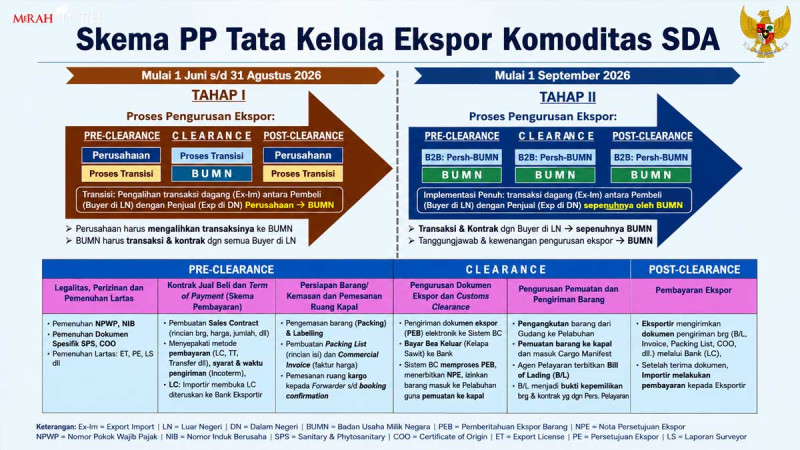
As part of its reform agenda, the government plans to issue a new Government Regulation on the Export Governance of Natural Resource Commodities. The policy will initially target strategic commodities such as palm oil, coal, and selected minerals.
Under the proposed mechanism, exports would be conducted through a government-appointed state-owned enterprise acting as a single exporter. Export proceeds would then be distributed to the relevant commodity producers and businesses.
Prabowo said the policy aims to strengthen export supervision while reducing under-invoicing, transfer pricing, and capital flight.
“We do not want to be deceived anymore. The state must know in detail the natural resources being sold abroad,” he asserted.
The President added that several resource-rich countries, including Saudi Arabia, Russia, Algeria, Malaysia, and Vietnam, have already implemented stricter governance systems for strategic commodity trade.
Prabowo estimated that Indonesia could potentially recover up to US$150 billion annually by curbing illegal trade practices and improving export governance. (T2)