InfoSAWIT, JAKARTA – The government’s plan to restructure the export governance of natural resource commodities through Danantara Sumberdaya Indonesia (DSI) should be positioned as a reform of supervision and trade transparency systems, rather than merely a change in the actor handling palm oil export transactions.
Sustainable palm oil observer from Universitas Trisakti, Dr. M. Windrawan Inantha, said the government’s efforts to strengthen oversight against practices such as under-invoicing, transfer pricing, and foreign exchange retention are important objectives. However, he emphasized that the policy’s implementation must take into account the complexity of Indonesia’s palm oil trade chain.
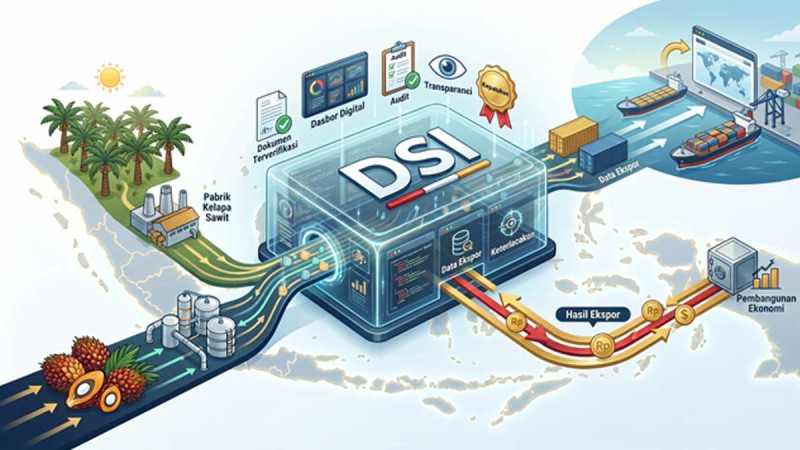
“The main issue in exports is not merely who the exporter is, but whether the state has full visibility over volumes, prices, destination markets, foreign exchange earnings, taxes, and compliance documents. DSI should be developed as an engine of transparency and market discipline,” Windrawan said in his official statement to InfoSAWIT on Wednesday (20/5/2026).
He explained that Indonesia’s palm oil exports cover not only crude palm oil (CPO), but also various downstream products such as refined palm oil, olein, stearin, PFAD, palm kernel oil, oleochemicals, and biodiesel-linked products, each with different technical specifications and trading contracts.
According to Windrawan, the term “marketing facility” appearing in the government’s policy direction must be interpreted carefully. DSI could become a strategic platform if it functions as a digitalized and transparent trading system capable of integrating export data, customs, banking, and sustainability certification systems.
Traceability Becomes a Key Factor
In the global palm oil trade, Windrawan noted that shipping speed and market trust are crucial elements. Many international buyers already maintain long-term contracts with Indonesian exporters covering pricing formulas, product quality, delivery schedules, and sustainability documentation.
The European market, for example, is increasingly demanding stronger traceability systems and due diligence compliance through the implementation of the European Union Deforestation Regulation (EUDR). In addition, many export destination markets also require compliance with certifications such as ISPO, RSPO, and ISCC.
“In the palm oil industry, traceability is not merely a marketing accessory. It has become a market entry requirement. If sustainability documents and product identities become unclear, what will suffer is not only the exporters’ reputation, but also Indonesia’s position in the global market,” Windrawan stated.
He added that if DSI becomes involved in the palm oil export system, the institution must also be capable of serving as a traceability integration hub to ensure product identity, supply origins, and certification documents remain properly maintained.
Five Issues the Government Must Clarify
Windrawan believes the government needs to immediately clarify several technical aspects to ensure the export reform does not disrupt the market. These include DSI’s legal position in export transactions, transition mechanisms for ongoing contracts, pricing formulas and service fees, dispute settlement mechanisms, and guarantees to protect fresh fruit bunch (FFB) prices for smallholder palm oil farmers.
He also urged the government to involve exporters, refiners, traders, banks, customs authorities, farmer associations, certification bodies, and international buyers in policy discussions. According to him, policies formulated without the involvement of industry stakeholders risk creating new barriers in Indonesia’s palm oil trade.
“Indonesia does not have to choose between state supervision and market capability. Both must work together. DSI can become an important instrument if it ensures every shipment is visible, every dollar is traceable, and every sustainability claim can be verified,” he said.
Windrawan stressed that the success of palm oil export reform must ultimately be measured by tangible outcomes, including improved export data accuracy, higher state revenue, stronger foreign exchange retention, reduced under-invoicing practices, preserved confidence among international buyers, and continued protection for palm oil smallholders. (T2)