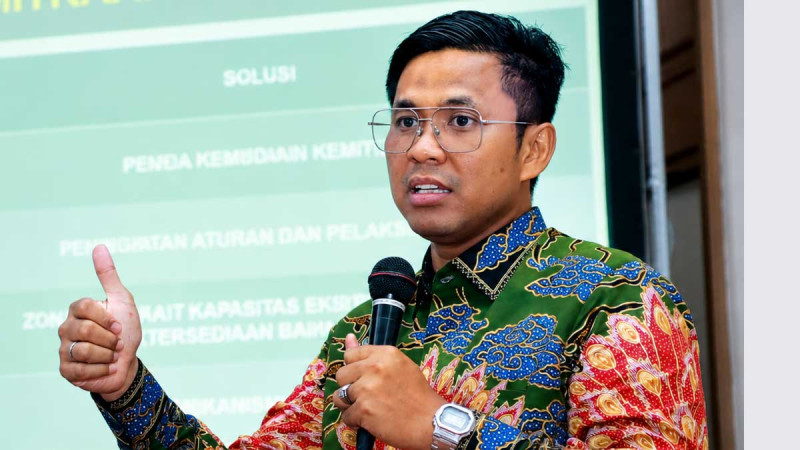
InfoSAWIT, JAKARTA – The Indonesian Palm Oil Association (GAPKI) has revealed that a significant number of partnership-based Smallholder Palm Oil Replanting Program (PSR) applications continue to fail during both administrative and field verification stages, highlighting persistent structural and regulatory challenges facing Indonesia’s replanting efforts.
Head of GAPKI’s PSR Policy and Socialization Division, Muhamad Iqbal, said legal documentation issues, land status complications, and technical inconsistencies remain the primary obstacles slowing down the acceleration of the national replanting program.
Speaking during a discussion organized by the Agricultural Journalists Forum (Forwatan) attended by InfoSAWIT on Tuesday (19/5/2026), Iqbal outlined several recurring factors that prevent partnership-based PSR proposals from advancing through the verification process.
At the administrative or on desk verification stage, GAPKI identified five major issues causing applications to be rejected before field inspections could even begin. These include expired plantation business permit documents from partner companies, the absence of non-overlapping land certificates with cultivation rights (HGU), and proposed smallholder land located within forest areas.
The organization also found cases where farmers’ land overlapped with existing HGU concessions, along with invalid or incomplete farmer data submissions.
Meanwhile, during on site verification, GAPKI recorded at least five additional issues preventing applications from proceeding to the technical recommendation stage (rekomtek). Among the most common findings were land cover that turned out not to be oil palm plantations, discrepancies between submitted documents and actual field conditions, as well as mismatched land coordinates.
“There are also many cases where farmers withdraw from the program, cannot be contacted, or have even passed away before verification is completed,” Iqbal explained.
According to him, implementation of partnership-based PSR schemes continues to face broader structural challenges on the ground. One of the most difficult hurdles remains obtaining official recommendations confirming that proposed land is outside forest zones and HGU concession areas.
Iqbal added that investigations by law enforcement authorities into farmer cooperatives, farmer groups, and PSR-related institutions have also affected program implementation in several regions.
Another major issue involves land ownership certificates still being used as collateral at financial institutions, while many land titles are registered under different names, complicating the process of securing co-financing for replanting activities.
At the same time, currently high fresh fruit bunch (FFB) prices have reduced farmers’ willingness to participate in replanting programs, as many still consider their existing plantations profitable.
“Many farmers eventually refuse replanting because FFB prices are currently quite favorable,” Iqbal said.
He also criticized the verification process conducted by SUCOFINDO, which he described as too rigid, particularly for plasma plantations that should ideally follow a simpler mechanism.
To accelerate PSR realization, GAPKI has prepared several strategic measures, including improving understanding of regulations, strengthening program planning, and intensifying gradual outreach to plasma farmers.
The association also emphasized the importance of digitizing farmer and land documents to simplify administrative processes and data validation. In addition, GAPKI is encouraging stronger strategic partnerships between companies, farmers, government institutions, and financing agencies.
“Monitoring and evaluation must be carried out regularly throughout every PSR business process so that emerging obstacles can be resolved quickly,” Iqbal noted.
In its conclusion, GAPKI stressed that PSR partnerships should not become the sole responsibility of plantation companies, but rather involve central and regional governments, smallholders, and farmer institutions collectively.
GAPKI also warned that the growing presence of palm oil mills operating without plantations and mills relying heavily on loose fruit collection could potentially undermine long-established partnership patterns in the palm oil sector.
The association further called for more adaptive regulations, arguing that there remains a significant gap between state financial administrative approaches and the realities faced by oil palm smallholders in the field.
According to GAPKI, the PSR program should become a momentum to build new partnerships between independent smallholders and companies, while also revitalizing partnership models that had previously weakened over time. (T2)