InfoSAWIT, JAKARTA – For two decades plantations companies and communities changed their actions to be environmental, social practices and everything now gets better.
But the issues always exist, such as, the bigger worry about climate change, carbon emission, natural conservation, people, income gap, labors, and human rights.
Chairman of the Singapore Institute of International Affairs, Simon SC Tay said that the many parties notice the issues and the responsibility for those that join Roundtable on Sustainable Palm Oil (RSPO). But it is proved that every RSPO member commits to reach out triple bottom line (environment, social, and governance/ESG) for the past 20 years.
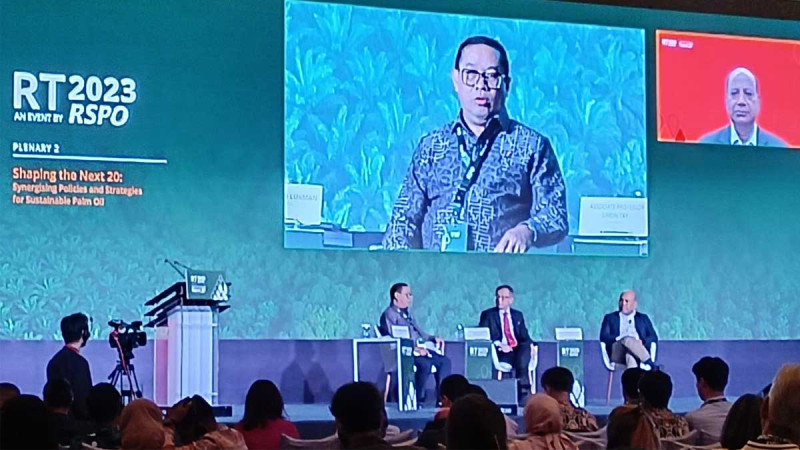
“We did many progress in the actions,” he said in a RSPO meeting session of Roundtable Conference (RT2023) with the theme ‘Shaping The Next 20: Synergizing Policies and Strategies for Sustainable Palm Oil’ that InfoSAWIT attended, Wednesday, (22/11/2023) in Jakarta.
Simon told that everything was improved when issues happened to get sustainable palm oil production. RSPO is the most advance standard in these industries. “Though we have other issues to be solved,” he said.
meanwhile Group Managing Director Sime Darby Plantation Berhad, Datuk Mohamad Helmy Othman Basha said many parties (organizations) did not pay attention to sustainable palm oil practices but sustainable palm oil are the words that many people tell and always say.
“But how many people do realize it, how many people do accept it,” Datuk Mohamad Helmy asked.
But sustainable policy (ies) would be very important because the world still faces uncertainty and it is ambiguous. That is why he continued that the world needs more sustainable.
“We know that palm oil has the closest standard criteria in sustainability. In oil and other vegetable oils, there is no sector that might stands out the most,” he said.
Datuk Mohamad Helmy mentioned the company would keep implementing sustainable practices to reinforce the commitment. “And would be tougher, really enable us for the next 20 year – actions, even for the 30 to 40 years to go,” he said.
General Secretary Council of Palm Oil Producing Countries (CPOPC), Rizal Affandi Lukman said that palm oil industries are the biggest vegetable oil industries in the world that are in transformation heading to use technology – base. Unfortunately, the industries are facing the difficult ones though RSPO is the most transparent standards of sustainability.
But Rizal continued palm oil industries have the closest standards in sustainability, for instance, there is RSPO, Indonesian Sustainable Palm Oil, and (ISPO) Malaysian Sustainable Palm Oil (MSPO).
Every sustainable certification, Rizal told, has its principles and criteria, for instance, ISPO has 7 principles, 30 criteria, and 174 indicators; MSPO has 5 principles, 28 criteria, and 88 indicators.
“Palm oil standards become the strongest sustainability standards, made palm oil tougher as it were an athlete that was trained and joining many competitions and ready to face what would come,” he said.
Rizal told that the cooperation in Council of Palm Oil Producing Countries (CPOPC) is quite simple, which is, to deliver advocacy in sustainable development through many ways. CPOPC is ready to help and cooperate with many policy makers and stakeholders to know how to solve the challenges that the industries face globally, confirm the smallholders’ welfare, and protect national parks.
“It needs to get membership expansion and reinforcement to realize the goals globally and positively deliver impacts for sustainable palm oil industries and implementation to labors’ protection,” he said. (T2)