InfoSAWIT, JAKARTA – In the book about Fact Kelapa Sawit published by Indonesian Palm Oil Board with Tim Advokasi Minyak Sawit Indonesia (TAMSI), fact 6 to 9 noted about palm oil morphology.
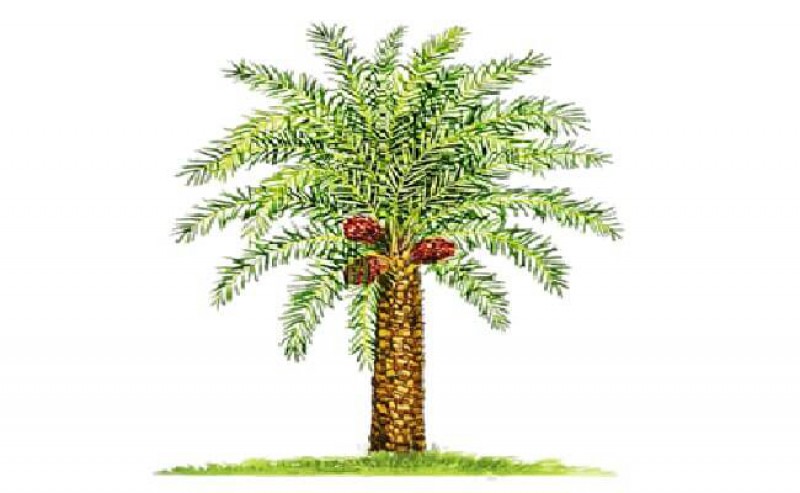
Fact 6 noted palm oil is monocot plantation that has fibrous roots. The tree can grow up to 35 - 75 cm per year and at the age of 25 years old, the height could be 15 -18 meters. Source: Central Data of InfoSAWIT (2010).
Leaf (leaves)
Palm oil tree has compound leaves. They are old green and the midribs are green light – color. The appearance is like snake fruit but the thorn is not sharp and hard.
Palm oil leaves consist of some parts:
a) leaflets that have sheets (lamina) and midrib.
b) Rachis which is the spot where midrib attaches
c) leaf stalk (petiole) which is a spot between leaf and stalk
d) leaf sheath which functions to protect leaf bud and delivers strength to the stalk. The leaf could get wider progressively at the age of 8 - 10 years old after being planted.
Fruit
Fruit type division based on the fruit skin color can be grouped to be three types, they are:
a. Nigrencens, it is blacky purple when being immature and would change to be blackish orange when being mature. This type is mostly found at the Tenera which was commercially planted in Indonesia.
b. Virescens, it is green when being immature and change to be reddish orange but the edge is still greenish.
c. Albescens, it is whitish when being immature while in mature it would be yellowish and the edge would be blackish purple.
Fresh fruit bunch that comes up from every midrib consists of pericarp which is wrapped by exocarp (fruit skin), mesocarp (fruit fiber), and endocarp (shell).
Palm oil chemical composition in mesocarp (crude palm oil) is different from oil in mature endosperm (palm kernel oil).
Flower
Palm oil is monoecious plantation which means, male and female flowers are in one tree but not in the same bunch though sometimes, there are male and female flowers at one bunch (hermafrodit).
Stem
The stem is covered by the former of leaf midrib until the tree is about 11 - 15 years old. After the numbers of age, the former midrib which got dried would be falling apart to be alike with the coconut tree. In general, the height growth of palm oil tree could be reaching 35 - 75 cm per year but it depends on the environment and genetics.
Root
The compound root in palm oil tree consists of primary, secondary, and tertiary, and quaternary roots. The main functions (1) to support the stem on the ground, (2) water and nutrient absorption in the soil, and (3) as one respiration tool.
Fact 7 revealed, palm oil in Indonesia consists of three varieties, they are, Dura, Pisifera, and Tenera. The fruit from each variety has difference from its shell, thickness of flesh, and yield. Source: Hariyadi (2010).
Fact 8 noted, the typology and kinds of soil in Indonesia which are podzolic, alluvial, and latosol, particularly in Sumatera, Kalimantan, Sulawesi, and Papua are good to grow it. Source: Pusat Penelitian Tanah dan Agroklimat (1993).
Fact 9 noted, as one tropical country within rain about 2000 – 2500 mm/year, dry month about 2 - 3 months/year, and temperature 24 - 28o C in average, Indonesia is good country to develop palm oil plantations. Source: Pahan (2006).
Source: “Fact Kelapa Sawit Indonesia” by Tim Advokasi Minyak Sawit Indonesia - Dewan Minyak Sawit Indonesia (TAMSI-DMSI).