InfoSAWIT, JAKARTA – Achieving high productivity in oil palm plantations is not simply a matter of applying more fertilizer or pursuing a higher production target. It requires an integrated system that connects planting material, agronomy, human resources, data, infrastructure and disciplined execution.
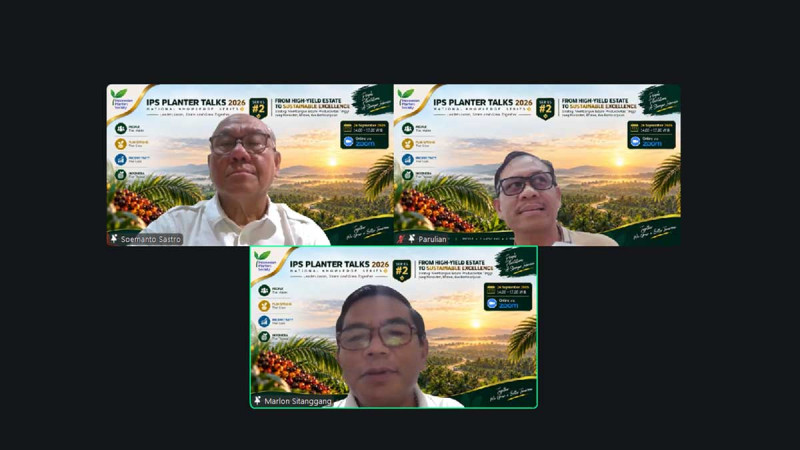
That was the central theme of IPS Planter Talks 2026 – National Knowledge Series #2, organized by the Indonesian Planters Society (IPS) on Saturday (Sept 26, 2026).
The second series carried the theme “From High-Yield Estate to Sustainable Excellence: How Top Estate Achieves >30 Ton/Ha”, bringing together Marlon Sitanggang, Head of Agronomy Division at PT Union Sampoerna Triputra Persada, and senior planter Soemanto Sastro.
IPS Chairman Jamalul said productivity was a fundamental issue in plantation operations. Following the first series, which focused on human resources under the theme “Darurat SDM Sawit – No Harvester, No Revenue,” the second discussion turned to the estate’s ability to consistently deliver high yields.
“High yield is not the result of one program, one fertilizer or one year of work. High yield is a system,” Jamalul said.
Measuring Yield Potential
During the session titled “Building the High-Yield Estate,” Marlon explained that oil palm productivity is shaped by the interaction of Genotype × Environment × Management.
This approach means that a target of more than 30 tonnes of fresh fruit bunches (FFB) per hectare cannot simply be applied uniformly across estates.
Instead, production targets need to reflect the genetic potential of the planting material, environmental conditions and the quality of plantation management.
Marlon outlined a process beginning with the identification of realistic yield potential. Estates then need to measure the yield gap, identify limiting factors, establish priorities, implement corrective measures and verify the results.
The discussion covered fundamental areas ranging from agronomy and plant nutrition to fertilizer effectiveness, harvesting quality, infrastructure and data-driven agronomy.
Recovering Hidden Production
One issue highlighted during the discussion was “hidden production”—production potential that exists in the field but fails to become recorded output.
Such losses can occur when ripe bunches are left unharvested, loose fruits are not collected, harvesting maturity is below standard, harvested fruit remains too long before transport, supervision is weak or harvesting and transportation access is inadequate.
Senior planter Soemanto Sastro offered an operational perspective, noting that production is determined long before harvesting takes place.
Soil condition, climate, planting material, field practices and fertilization all contribute to eventual productivity.
The process begins with quality planting material and a first-class nursery, followed by proper planting, maintaining full stand and crop uniformity, balanced fertilization, crop maintenance, infrastructure readiness and harvesting according to standards.
Transport after harvesting is equally important.
The zero-restan principle is intended to ensure harvested FFB reaches the palm oil mill as quickly as possible. At the processing stage, controlling losses and maintaining accurate administration are also essential to prevent field production from being lost further along the supply chain.
Productivity Requires Consistent Execution
The discussion underscored the relationship between production potential and operational execution.
Genetics and environmental conditions establish the production foundation, but the ability to realize that potential depends heavily on work systems, workforce quality, supervision, infrastructure, data and operational discipline.
IPS Planter Talks 2026 consists of eight series covering strategic plantation issues, including human resources, estate productivity, technology and artificial intelligence, the future of palm oil mills, leadership and the next generation of planters.
The next session, Series #3, is scheduled for Oct. 10, 2026, focusing on data-driven plantation transformation, IoT, analytics and artificial intelligence under the theme “From Data to Decisions, From Insight to Impact.”
The series will examine how field data, GIS, connectivity, real-time monitoring, analytics and predictive AI can be integrated from plantations to palm oil mills to support productivity, efficiency and decision-making.
Ultimately, IPS Planter Talks Series #2 positioned high yield not merely as a production number, but as the outcome of a system capable of consistently converting plantation potential into efficient and sustainable performance. (T2)
Source: InfoSAWIT