InfoSAWIT, JAKARTA – Indonesia's National Research and Innovation Agency (BRIN) is advancing pyrolysis technology to transform oil palm empty fruit bunches (EFB) into renewable energy and high-value industrial feedstocks, offering a sustainable solution for one of the palm oil industry's largest biomass waste streams.
The initiative is expected to strengthen Indonesia's energy transition while promoting a circular economy by maximizing the utilization of oil palm biomass that has traditionally been underutilized.
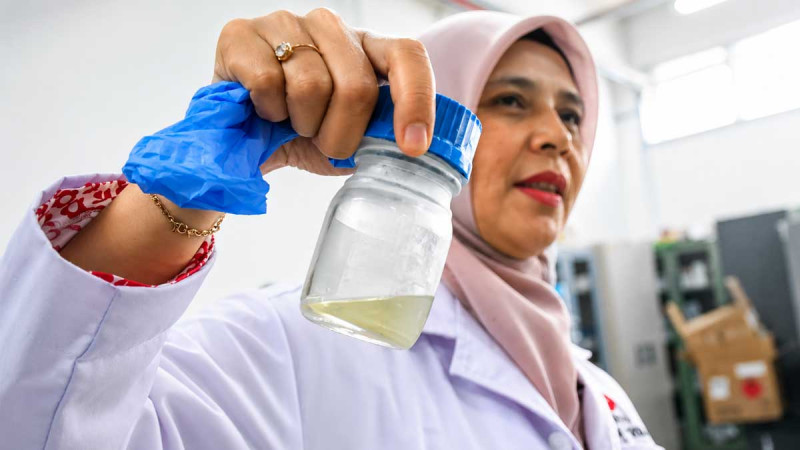
According to a statement received by InfoSAWIT on Thursday (July 2, 2026), Dieni Mansur, Head of the Biomass Oil Pyrolysis Research Team at BRIN's Research Center for Molecular Chemistry, said biomass conversion plays a strategic role in reducing the country's dependence on fossil fuels while creating new value from agricultural residues.
"Pyrolysis oil is being developed to support Indonesia's energy diversification. Meanwhile, oil palm empty fruit bunches are generated in enormous volumes, making their optimal utilization increasingly important," Dieni said.
Pyrolysis converts biomass into valuable products by heating organic material in the absence of oxygen. BRIN currently operates a reactor capable of processing EFB using a slow pyrolysis method, with each production cycle taking approximately two to four hours.
The process produces three primary products—liquid smoke, bio-oil, and biochar—each with promising commercial applications across multiple industries.
Liquid smoke, for example, has potential as a natural coating to extend the shelf life of fresh fruit. Research has also demonstrated its potential application in film-based materials designed to support oral wound healing.
Meanwhile, bio-oil and liquid smoke contain a variety of valuable organic compounds, including phenols, acetic acid, ketones, and methanol, which are widely used as feedstocks in the chemical industry.
Dieni explained that bio-oil derived from oil palm EFB can already be utilized as boiler fuel for industrial operations. Although it is not yet suitable as a direct transportation fuel, its chemical composition offers significant potential for development as an additive in liquid fuels, including gasoline.
"This opens up new opportunities to utilize oil palm biomass waste as both an alternative energy source and a sustainable bio-based chemical feedstock," she said.
Beyond addressing biomass disposal challenges, the technology is expected to support renewable energy development while generating additional economic value for Indonesia's palm oil sector. The approach also aligns with circular economy principles by improving resource efficiency and reducing environmental impacts.
Looking ahead, BRIN hopes the technology will be adopted more widely across the palm oil industry, helping reduce biomass waste, strengthen national energy security, and increase the value-added contribution of Indonesia's palm oil sector.
With Indonesia possessing one of the world's largest oil palm biomass resources, pyrolysis technology is viewed as a strategic pathway to accelerate renewable energy development based on domestic resources while supporting the country's transition toward a greener and more sustainable economy. (T2)