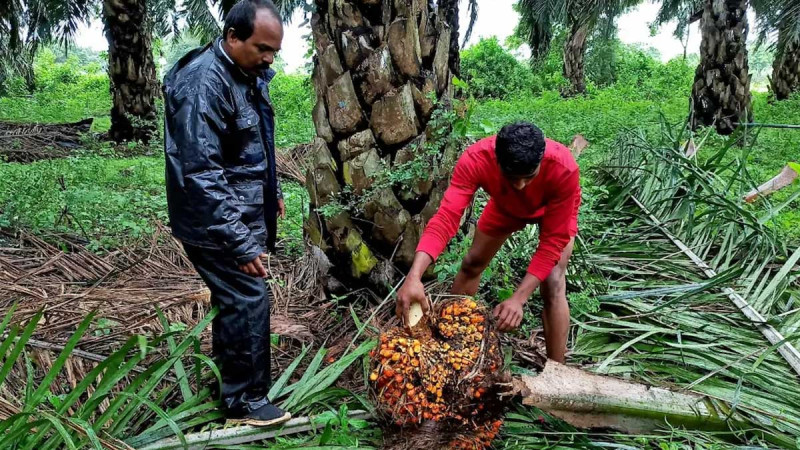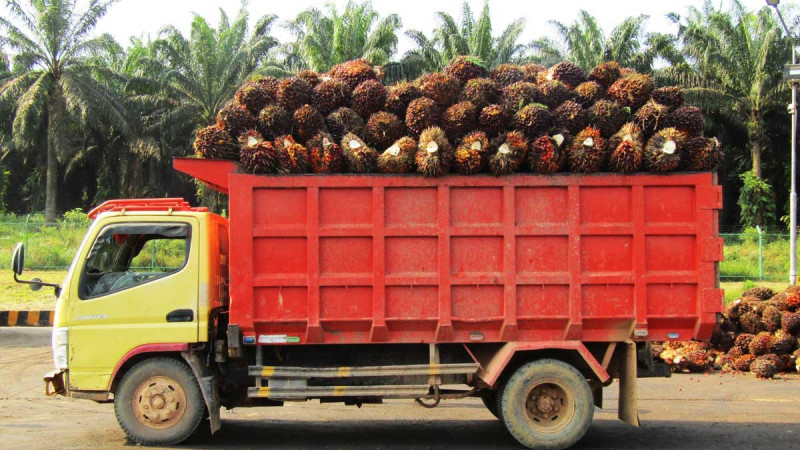
InfoSAWIT, JAKARTA – Indonesia’s Smallholder Palm Oil Replanting Program (PSR) continues to face major obstacles, ranging from land legality issues and overlapping regulations to farmers’ concerns over losing income during the replanting period.
Director of Palm Oil and Various Palma Crops (SALMA) at the Ministry of Agriculture, Iim Mucharam, said improving the productivity of smallholder plantations remains the most realistic strategy for strengthening Indonesia’s palm oil industry instead of continuing land expansion.
Speaking during a discussion organized by the Agricultural Journalists Forum (Forwatan), attended by InfoSAWIT on Tuesday (19/5/2026), Iim explained that the oil palm plantation sector is still burdened by long-standing structural challenges, including forest area disputes, lengthy supply chains, and governance issues requiring urgent reform.
“If smallholder productivity can be improved, that would be far better than continuously opening new land. The key lies in productivity enhancement,” he said.
According to him, the long palm oil supply chain also presents a major challenge, making farmer incentives essential to ensure the success of the replanting program.
Iim noted that since 2016 the government has implemented various initiatives to strengthen the smallholder sector, including the PSR program, infrastructure support, human resource development, and technical assistance.
The PSR program itself was designed to improve productivity among smallholder plantations. Financial support under the scheme has increased significantly, from Rp25 million per hectare during its initial phase to Rp60 million per hectare today.
“The government has provided substantial support to improve smallholder palm oil productivity,” he stated.
He added that PSR applications can currently be submitted through two channels: government agencies and partnership schemes.
Despite the large funding allocation prepared by the government, PSR implementation remains below expectations. One of the primary reasons is farmers’ reluctance to replant due to fears of losing income during the immature planting period.
Administrative procedures and land legality issues also remain major hurdles. Many smallholder plantations are not yet considered “clear and clean” because they potentially overlap with forest areas or land under cultivation rights permits (HGU).
In addition, farmers and local officials involved in PSR implementation reportedly face frequent summons from law enforcement agencies, which authorities believe has further reduced farmer participation in the program.
For that reason, the Ministry of Agriculture stressed the need for stronger cross-ministerial coordination to accelerate PSR implementation. Proposed measures include resolving forest area status issues through official letters from the Forest Area Utilization Agency (BPKH) and ensuring plantations do not overlap with HGU areas through land office verification.
At the end of the discussion, the government reiterated that the PSR program currently remains voluntary and cannot yet be fully implemented on a mandatory basis due to the absence of supporting regulations.
However, authorities suggested that a gradual mandatory approach based on incentives and technical readiness could become a future option.
The government also highlighted several key success factors for PSR, including guaranteed farmer income during the replanting period, stronger farmer institutions, simplified administrative requirements, and enhanced coordination among ministries and agencies. (T2)