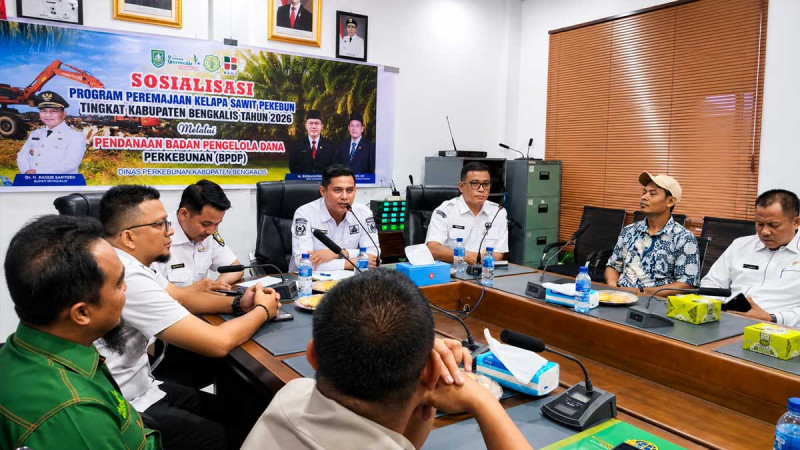
InfoSAWIT, BENGKALIS – The Bengkalis Regency Government in Riau has accelerated preparations for its 2026 Smallholders Replanting Program (PSR), targeting 300 hectares of community-owned oil palm plantations for rejuvenation as part of efforts to boost productivity and strengthen long-term sustainability.
The commitment was marked by a district-level socialization program on oil palm Smallholders replanting held by the Bengkalis Plantation Office at the Mandau subdistrict office, attended by growers from Mandau, Pinggir, and Bathin Solapan—three major Smallholders palm-producing areas in the regency.
The event featured speakers from Riau’s Plantation Office, the National Land Agency (BPN) Bengkalis branch, and the local chapter of the Sawitku Masa Depanku Association (SAMADE), offering growers practical guidance on technical requirements, land legality, and financing schemes available for replanting.
Representing Bengkalis Plantation Agency Head Sufandi, Production Division Head Adi Zulhami said plantations remain one of the main pillars of the regional economy, supporting both employment and rural livelihoods.
He noted that oil palm remains Bengkalis’ flagship commodity, but Smallholders continue to face structural challenges, including use of poor-quality seeds, aging trees beyond productive life cycles, and limited understanding of sustainable agronomic practices.
“Oil palm plantations make a significant contribution to the regional economy. However, productivity remains constrained by non-superior seeds, aging trees, and limited knowledge among Smallholders regarding good agricultural practices,” Adi said.
Preliminary 2025 data show Bengkalis has approximately 375,000 hectares of plantation area, dominated by Smallholders palm cultivation. Around 87.75% of total plantation land is independently managed by local communities, underscoring the central role of Smallholders in the region’s palm economy.
Recognizing this, the regency government is prioritizing replanting as a strategic productivity intervention backed by national policy support through the Ministry of Agriculture and funding from Indonesia’s palm oil fund agency.
Adi stressed that success will depend not only on funding, but on stronger partnerships between local government, field extension officers, grower institutions, and private sector partners.
“Partnership is key—from quality seed supply and technical mentoring to market access. All stakeholders must actively contribute to ensure the success of this program,” he said.
Through stronger outreach and collaboration, Bengkalis hopes more Smallholders will view replanting as an opportunity to improve plantation quality, raise fresh fruit bunch yields, and secure more sustainable incomes for rural communities. (T2)