InfoSAWIT, BANDUNG – Strengthening Indonesia's international negotiation capacity has become increasingly important as the global palm oil trade faces tighter sustainability standards and climate-related regulations. Industry experts believe stronger diplomacy will be essential to safeguard Indonesia's interests while opening new opportunities in international markets.
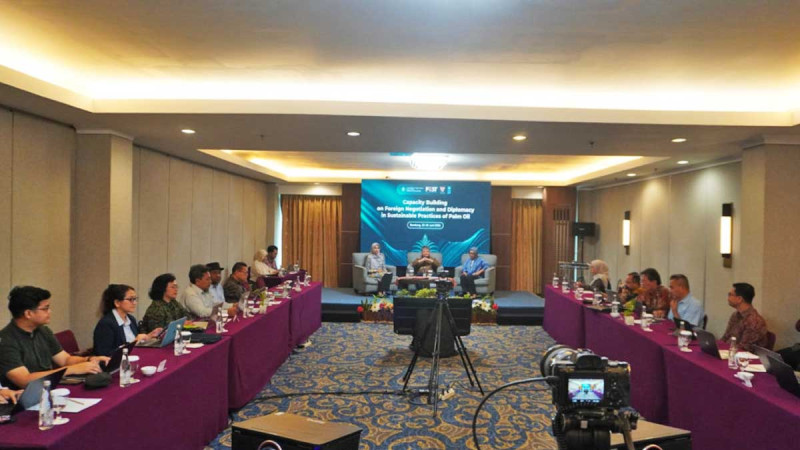
The issue was at the center of the Workshop on Developing a Capacity-Building Module for International Negotiation and Diplomacy on Sustainable Palm Oil, organized by the Center for World Trade Studies (PSPD), Universitas Gadjah Mada (UGM) in Bandung, West Java, from June 22–24, 2026.
According to Prof. Mirwan Ushada, UGM's Director of Research, the palm oil industry remains one of Indonesia's most strategic economic sectors, supporting millions of livelihoods, including independent smallholders. Given its significant contribution to the national economy, Indonesia must strengthen the capacity of its negotiators to navigate increasingly complex international trade discussions.
Speaking in remarks published on UGM's official website and obtained by InfoSAWIT on Monday (June 29, 2026), Mirwan said the training program combines theoretical learning with practical negotiation exercises to equip participants with stronger competencies for international forums.
"The international negotiation and diplomacy capacity-building program is designed through a combination of conceptual learning and practical exercises. The objective is to equip participants with stronger competencies to engage effectively in international negotiations," he said.
He added that better-prepared negotiators would help bridge Indonesia's national interests with evolving global market requirements while reinforcing the country's position in international discussions surrounding palm oil.
Also speaking at the workshop, Dr. Miftah Farid, Director of Primary Product Export Development at Indonesia's Ministry of Trade, said expanding export markets requires more than opening trade channels. Success also depends on understanding regulatory frameworks, consumer preferences, and strengthening product competitiveness.
He suggested Indonesia consider establishing a dedicated palm oil promotion agency similar to Malaysia's model. Such an institution, he said, could enhance trade diplomacy while addressing persistent negative campaigns targeting Indonesian palm oil overseas.
"A dedicated Palm Oil Promotion Agency could become the driving force behind promotional strategies while strengthening the narrative around sustainability, traceability, and the industry's significant social and economic contributions to Indonesia," Miftah explained.
Meanwhile, Dr. Rosediana Suharto, Executive Director of the Responsible Sustainable Palm Oil Initiatives, emphasized the importance of strengthening Indonesia's scientific evidence base to support future international negotiations.
She argued that stronger science-based arguments should be complemented by continuous improvements in environmental and social governance at home, reducing Indonesia's vulnerability to criticism in global trade discussions.
"We must have confidence in defending our own national capabilities. Opposition to palm oil is not driven entirely by environmental concerns, but also by efforts to protect domestic markets in certain countries," she said.
A similar view was expressed by Dr. Fadhil Hasan, member of Indonesia's National Energy Council (DEN) and Head of International Affairs at the Indonesian Palm Oil Association (GAPKI). He believes Indonesia should become more aggressive in developing non-traditional export destinations, particularly across Africa, South Asia, and the Middle East.
According to Fadhil, this strategy is becoming increasingly important as a larger share of domestic palm oil production is expected to be absorbed by Indonesia's B50 biodiesel program.
He noted that Indonesia already exports palm oil to around 160 countries, meaning the next challenge is not expanding the number of destinations but prioritizing markets with the strongest long-term growth potential.
"Palm oil is no longer viewed as a discounted oil. It has become a premium oil as its economic value continues to rise, supported in part by robust domestic consumption. Going forward, the industry's competitiveness cannot rely solely on price increases driven by geopolitical factors. It must be built on higher productivity, stronger research and development, and downstream industrialization," Fadhil said.
Through the workshop, organizers hope participants will strengthen Indonesia's diplomatic capabilities in defending the country's palm oil interests internationally. Beyond expanding export opportunities, stronger negotiation skills are expected to play a key role in reinforcing the global image of Indonesian sustainable palm oil. (T2)