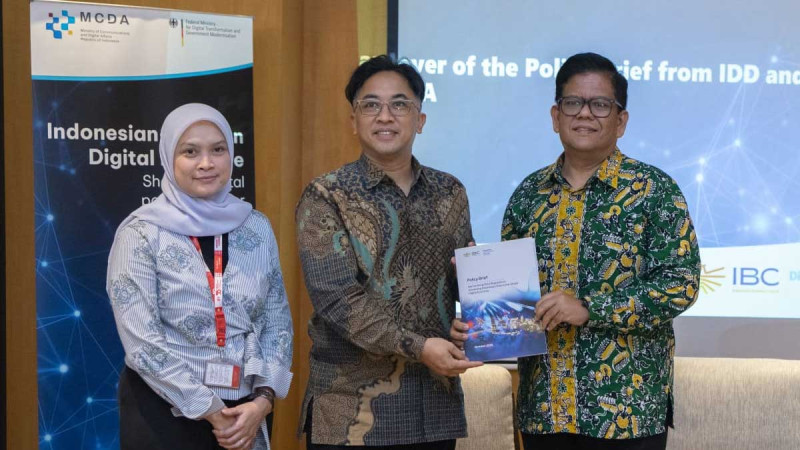
InfoSAWIT, JAKARTA — Efforts to strengthen Indonesia’s national data governance and accelerate digital transformation have gained fresh momentum. The Indonesian Business Council (IBC), together with the Indonesia–German Digital Dialogue Secretariat, officially launched the policy brief “Harmonizing Data Regulations” last Thursday.
The document presents a practical framework to unify core definitions and obligations in data governance, strengthen trusted cross-border data flow mechanisms, and reduce compliance friction for Indonesian businesses expanding to Europe and global markets.
The launch marks an important step toward digital data interoperability that not only aligns with national interests but also opens broader space for international collaboration.
Government Push: Clear and Integrated Data Governance
The Head of the Center for International Institutional Affairs at Indonesia’s Ministry of Communication and Digital, Ichwan Makmur Nasution, emphasized that Indonesia’s current priority is to establish clear, consistent, and interoperable data governance across sectors and countries.
“With trust embedded in digital data management, Indonesia can accelerate digital transformation, strengthen global partnerships, and ensure that the benefits of the digital economy are equitably distributed,” Ichwan said in a written statement received by InfoSAWIT on Sunday (Nov 9, 2025).
According to him, consistent regulation forms the foundation for building an inclusive, globally competitive digital ecosystem—while maintaining national data sovereignty and security.
Business Perspective: Legal Certainty and Cost Efficiency
From the business side, IBC believes that harmonizing data regulations across countries will reduce legal uncertainty and compliance costs, while expanding cross-border collaboration and financing.
IBC’s Director of Policy & Program, Prayoga Wiradisuria, stated that compatible regulations between countries can enhance data protection and facilitate digital collaboration across sectors.
“IBC is ready to bridge the government, industry, and international partners to translate policy recommendations into concrete actions—opening investment opportunities while ensuring fair competition for domestic players,” he noted.
He added that interoperability is a strategic key to balancing data protection and innovation. Through this approach, Indonesia’s digital commodities can compete globally without compromising data sovereignty.
The policy brief underscores the importance of trust in cross-border data flows. The developed model is expected to be adopted more broadly at regional and global levels, particularly within ASEAN–Europe cooperation frameworks.
In addition, IBC and the Indonesia–German Digital Dialogue Secretariat encourage ongoing dialogue among stakeholders—government, regulators, industry, and academia—to ensure that these policy recommendations evolve into measurable and impactful implementation steps.
As a follow-up, both institutions plan to hold technical dialogues and multi-stakeholder consultations to develop operational mechanisms supporting investment, digital exports, and data-driven innovation.
The launch of this policy brief marks a milestone toward harmonizing national and international data regulations—positioning Indonesia as a strategic player in the global digital economy.
A full copy of the “Harmonizing Data Regulations” policy brief is available upon request through IBC and the Indonesia–German Digital Dialogue Secretariat. (T2)