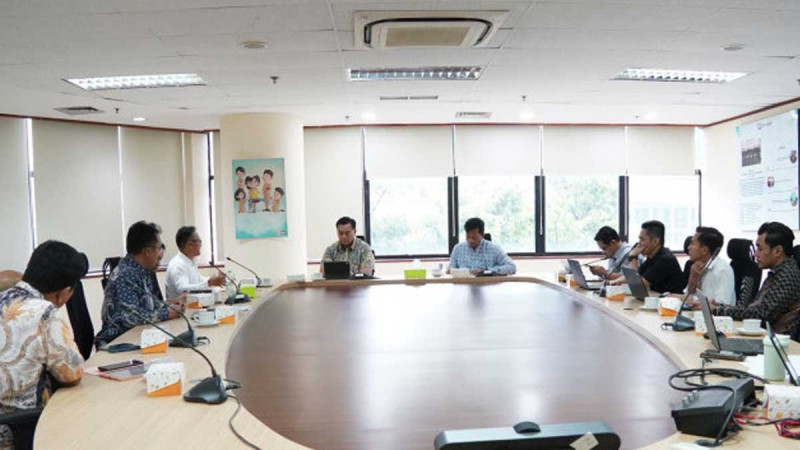
InfoSAWIT, JAKARTA – The Ombudsman of the Republic of Indonesia has opened a new collaboration space with the Indonesia Palm Oil Strategic Studies (IPOSS) research institution to strengthen sustainable palm oil industry governance. The meeting, held at the Ombudsman RI building in Jakarta on Wednesday (July 9, 2025), marks the beginning of a strategic partnership based on research and oversight of public services in the palm oil sector.
Ombudsman RI member Yeka Hendra Fatika revealed that the agency has recently completed a systemic study on the governance of the national palm oil industry. According to Yeka, this study serves as a strong foundation for the Ombudsman in formulating strategies to prevent and address maladministration, particularly in public service related to the palm oil sector.
“Our main task is to prevent and address maladministration. Our assessments are always based on facts and measurable indicators, not assumptions. We can only state that maladministration exists if there is an abuse of authority, legal violations, or harm to the public,” Yeka emphasized in an official statement written by InfoSAWIT on Friday (July 11, 2025).
He also explained that Ombudsman findings often lead to corrective actions and mandatory recommendations that frequently serve as evidence in legal processes. These recommendations also become important references in strengthening the governance of public service institutions, including in the palm oil sector.
During the discussion, IPOSS presented several strategic research agendas currently being developed, including mapping the origins of the palm oil industry in Indonesia and developing technology to utilize palm oil mill effluent (POME) as aircraft fuel. This innovation mimics the progressive steps taken by Malaysia.
IPOSS Director Nanang Hendarsah explained that IPOSS aims to bridge the gap between research and policy, focusing on the governance of the palm oil industry from upstream to downstream.
“We want to ensure that Indonesia's palm oil industry is not only environmentally sustainable but also economically and socially robust. One of the main challenges is building a comprehensive data system and untangling overlapping regulations that have confused industry players and farmers,” Nanang stated.
Nanang also highlighted the importance of improving public communication regarding the palm oil industry. He noted that there is still a lot of negative stigma surrounding palm oil that affects public opinion, especially among the younger generation. “Enhancing public literacy regarding the contributions of palm oil and its impacts on the environment must be part of the national strategy,” he added.
In response, Yeka welcomed the research approach offered by IPOSS. He believes that collaboration between oversight institutions and strategic research organizations like IPOSS can be a crucial driver in reforming the governance of the national palm oil industry.
“If we seriously and systematically improve the governance of the palm oil industry, the potential for increased state revenue could reach Rp200 trillion. But this requires commitment and the presence of a dedicated national institution that is focused and integrated in addressing palm oil issues,” Yeka explained.
Yeka also emphasized the importance of learning from other countries, such as Malaysia, which, despite having smaller land areas than Indonesia, has achieved high productivity and superior harvest quality. “We need to adapt best practices from abroad to the Indonesian context for optimal results,” he said.
This meeting signals a positive step towards strengthening the governance of the palm oil industry, which has long faced various structural and institutional challenges. The Ombudsman RI hopes that this partnership will not only produce recommendations but also concrete steps to ensure that public services in the palm oil sector operate transparently, accountably, and justly.
“We welcome the collaboration with IPOSS. The synergy between oversight and research is key to achieving genuine reform in the palm oil sector,” Yeka concluded. (T2)