
InfoSAWIT, JAKARTA - The implementation of palm oil – cow integrated program in some regions now shows positive trends. It involved 891 smallholders and 32 palm oil plantation companies with 116 thousand hectares plantations in four provinces.
To get mutual benefits between smallholders and palm oil plantation companies (for the rest, it would be ‘companies’), SISKA Supporting Program was established as the form of success.
The facts showed, feeding animals (cows) managed by SISKA model has been proved to be profitable for the companies, such as, significantly minimize cost to process wastes, the implementation of electric fence prevents not only fresh fruit bunch (FFB) stealing but also confirm a 24/7 monitoring by the smallholders, and escalate the security in a whole.
The collaborative efforts led by Gabungan Pelaku dan Pemerhati Sistem Integrasi Sapi – Kelapa Sawit (Gapensiska), and PT Simbiosis Karya Agroindustri (SISKA) delivered incredible progress.
There have been 51 smallholders’ groups involved. They consist of 891 smallholders in cooperation with 32 companies that breed more than 7.000 cows on a 116.000 hectare- palm oil plantations in four provinces, they are, South Kalimantan, West Kalimantan, East Kalimantan and Riau.
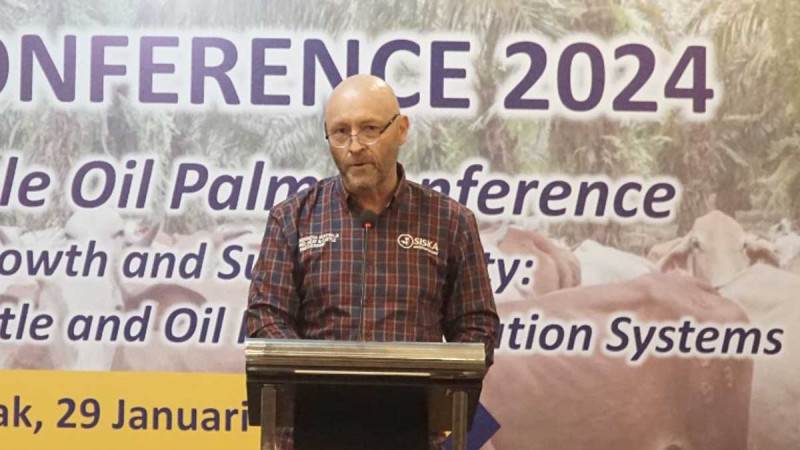
“These are incredible achievements because of it in a relatively short period, Team Leader, Advisory Support Group, Indonesia Australia Red Meat and Cattle Partnership (IAR-RMCP), Stuart McAdam in an international seminar ‘The 2nd Integrated Cattle and Oil-Palm Production (ICOP) Conference 2024 by the late of January 2024 that InfoSAWIT attended in Pontianak.
SISKA Supporting Program would be about to end, believed that sustainable development would remain high namely because of dedication of Gapensiska and PT SISKA. The successful program reflected the positive impacts from collaborative initiatives to encourage agricultural innovation and get harmonious relationship between smallholders and the companies.
Stuart McAdam told that organic fertilizers from animals’ feces would effectively encourage to minimize herbicide uses, and weeds and grass consumption did also contribute for sustainable agricultural practices.
“SISKA model has become the stone for the companies’ social responsibility, reinforced relationship, developed dynamic that delivered profits between smallholders and the companies,” he said. (T2)
For more, please read Majalah InfoSAWIT, February 2024