
InfoSAWIT, JAKARTA - One action to control the rats which may decrease the palm oil productivity, may be using the natural agent, that is, owl. Besides being environmental, it could decrease the chemical ingredients application in the plantation.
Rat is a rodent animal as the main pest in the palm oil plantation for it may decrease the production, both the quality and quantity of the fresh fruit bunch (FFB) and could make non-productive plantation before it is mature. In the immature tree, rat will eat the stalk of the tree until tree is dead. While in the mature tree, the rat will eat the male flower and the FFB so it decreases the production and increases the free fatty acid (FFA) or decreases the quality of crude palm oil (CPO) (Rajagukguk, B, 2014).
In general, to control the rats could be done by chemical usage, such as, ‘redontisida sistem campain’ both ‘antikoagulan generasi 1’ and ‘antikoagulan generasi 2’. But to control the rat chemically, it is not satisfied yet, both in the decreasing numbers when control it, the money spent, and the impact to the environment.
Biological control is the alternative one to use for it is sustainable and environmental. In the long term, the money will be much money to spend rather than it in chemical ways. Some methods in controlling the pest (rat) biologically have been done by some plantation companies, such as, using cobra. But it influenced the safety of the workers. So breeding owls (Tyto alba) is the alternative to control the rats environmentally and sustainably to decrease the numbers of rats in the plantation (Sipayung, A. 1990).
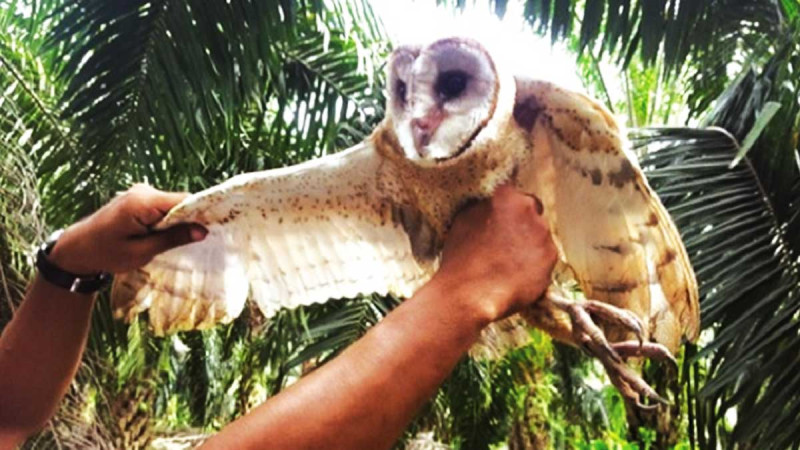
Owl (Tyto alba) is chosen for it is the predator to the rats in the palm oil plantation. It is noctural (active in the night) and 99% of its food are rats and 1% is bugs. Tyto Alba attacks well and could eat 2 to 7 rats in every single night. It could kill more than what it needs (Setiawan, 2014).
It needs to notice, breeding owls in palm oil plantation needs ‘gupon’ or cage, routine monitoring, managing the place of breeding, and the spread of owl should be based on its characteristic. Breeding owls in PT Salonok Ladang Mas (SLM) (USTP Group) has been running since in the end of 2013 until now within the goal is to control rats intensively and sustainably. The breeding of owls in PT SLM has good results. This success happens for the top management of PT SLM commits and it is supported by the workers within the cooperation from the plot workers and the Pest and Disease Team. (PDT).
Advantaging the Breeding Cage
The cage to breed used by PT Salonok Ladang Mas is 5 meter in width and 4 meter in length. Its inside cage is like a hen cage within 2,5 meter in width, 1 meter in length and 50 cm in height. The cage functions as the place to rest and home to owls. The outside cage functions as the media to breed the baby owl. The cage triggers others because owls like to gather in the afternoon before they hunt the rats. The baby owl will be in the cage and call the others in the afternoon to gather.
Breding owls using cage has many functions. It could be the media as the trigger to the local owls which might have lived or stayed in the area. It could be the place to gather in the afternoon. The location of the cage could be the center of breeding owls. Around it, the ‘gupon’ will be put within the ratio, 1 unit ‘gupon’ for 25 hectares.
In the first phase, it will be introduced to owls around the cage and they should be in the cage for about 2 weeks and feed by giving the rats whose feet have been cut off. Its goal is that the owls know the ‘gupon’. The owls will hunt around the cage. But before it, the owls will gather around the cage. Giving the living rats is that the owls’ instict will be stable though the man has interfered to breed the owls.
This method makes the positive result to make colony of owls in the plot. In less than 3 months, the owls live in 6 of 10 ‘gupon’ made. Two of them are productive. The next phase is the evacuation process of the baby owls within two months old (8 weeks) to be bred and trained until the baby owl could be introduced to the inactive gupon. It needs to notice the woof, flying training which the trainers do so that the baby owls could be qualified in the ‘gupon’. (*)
By: Salahuddin Adi Kelana, Avi Damayanthi, Ruben S, Marlon S/ Tim Agronomi at PT Union Sampoerna Triputra Persada
Source: Majalah InfoSAWIT, March 2017