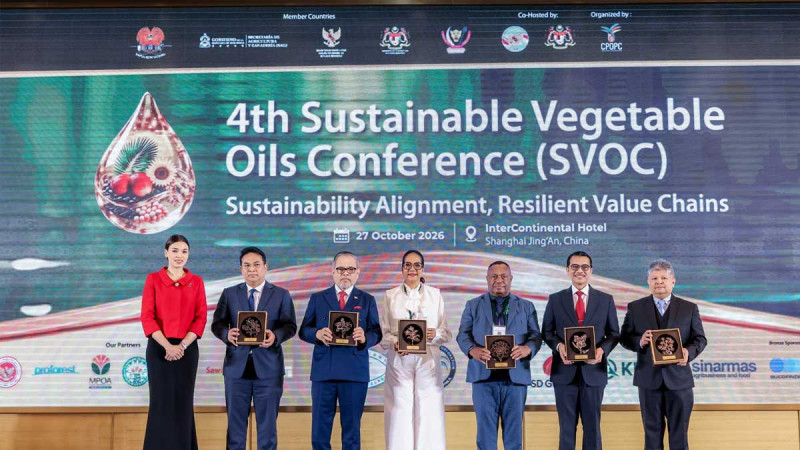
InfoSAWIT, SHANGHAI – Innovation, productivity and international cooperation took centre stage at the fourth Sustainable Vegetable Oils Conference (SVOC), organised by the Council of Palm Oil Producing Countries (CPOPC) in Shanghai, China, on October 27, 2026.
Held under the theme “Sustainability Alignment, Resilient Value Chains,” the conference brought together more than 200 participants from 11 countries, including government representatives, industry leaders, international organisations and experts from the palm oil, soybean, rapeseed and sunflower oil sectors.
CPOPC Secretary-General Izzana Salleh emphasised that closer cooperation between producing and consuming countries is essential as vegetable oil markets face price volatility and regulatory uncertainty.
“Relative price changes can shift purchasing decisions between vegetable oils, while regulatory uncertainty can affect trade flows and investment confidence,” Izzana said in a statement received by InfoSAWIT on Thursday, October 29.
She added that resilient supply chains require reliable market information, diversified trading relationships, efficient logistics and predictable policy frameworks.
Global vegetable oil production in 2026 is projected at approximately 234 million tonnes, with palm oil accounting for around 85 million tonnes, or more than one-third of the total.
China featured prominently in discussions as a major consumer and strategic trading partner. Its vegetable oil consumption in 2025 was estimated at 35.8 million tonnes, including 5.07 million tonnes of palm oil.
Indonesia’s Coordinating Minister for Economic Affairs, Airlangga Hartarto, highlighted the importance of improving smallholder productivity without expanding plantation areas. Malaysia’s Plantation and Commodities Minister, Noraini Ahmad, stressed the need for sustainability standards that support producers’ access to global markets.
Conference sessions explored agricultural technology, improved planting materials, mechanisation, precision agronomy and sustainable production standards.
Participants also discussed Indonesia’s B50 biodiesel policy, Malaysia’s palm-based biofuel development and efforts by the Democratic Republic of Congo and Papua New Guinea to strengthen palm oil value chains and support smallholders.
Through SVOC, CPOPC aims to deepen dialogue between producers, consumers, industry players and sustainability partners, while advancing practical cooperation to improve productivity, transparency and global competitiveness. (T2)