InfoSAWIT, BANDUNG – Indonesia often speaks boldly about energy security. Biodiesel mandates are expanding, the renewable energy mix is being strengthened, fuel imports are being reduced, and palm oil is once again being positioned as a strategic pillar of national energy policy. Yet amid this momentum lies a striking irony: Indonesia is not truly short of energy resources—it is struggling to unlock the enormous energy potential already growing in its own plantations.
The problem is not land. Nor climate. Nor even market demand. The more fundamental issue lies elsewhere—many of Indonesia’s oil palm plantations are simply not being managed as they should be.
From an economic standpoint, the figures are difficult to ignore.
Indonesia’s total palm oil production—combining crude palm oil and palm kernel oil—reached around 52.8 million tons in 2024. While substantial, that figure is only halfway toward its estimated real production potential, which could exceed 100 million tons annually. The gap between actual output and achievable productivity is vast.
That gap, many observers argue, represents lost economic opportunity worth an estimated Rp800 trillion to Rp1 quadrillion every year.
For a country seeking energy self-sufficiency, stronger biofuel capacity, and broader rural economic growth, that scale of untapped potential is more than a missed opportunity—it is a national luxury being wasted.
Palm Trees Left to Grow on Their Own
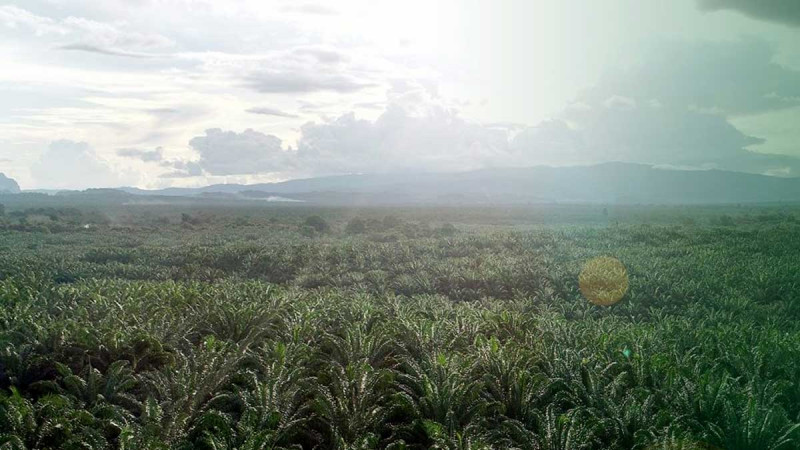
Indonesia’s palm oil challenge is not about crops failing to grow. In fact, the trees continue to grow. But many plantations are left to operate largely on their own, with little professional management.
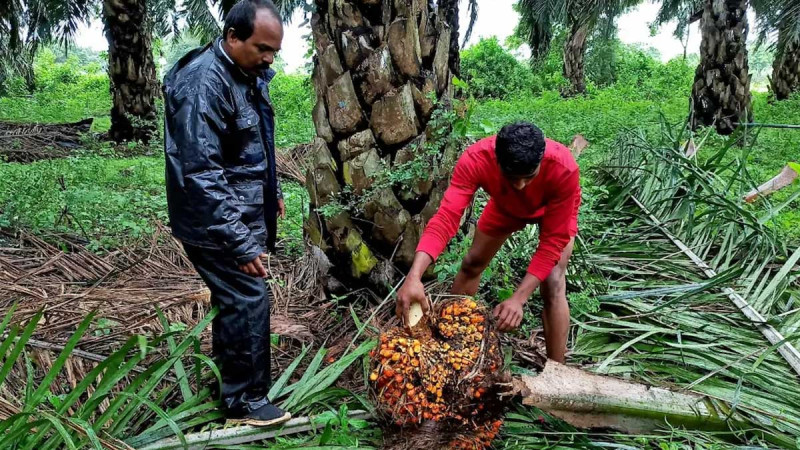
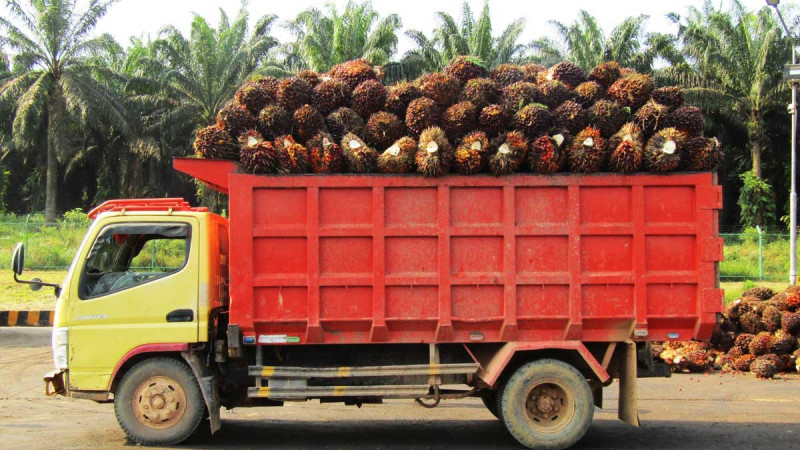
Fertilization is often inadequate. Crop maintenance is neglected. Harvest roads remain damaged for years. Drainage systems fail. Weeds overtake plantation canopies. Harvesting is delayed. Overripe bunches are missed. Loose fruits are left behind. In some cases, fresh fruit bunches never even reach the mills due to poor transportation access.
In many plantations, harvesting is concentrated only on outer blocks, while inner sections gradually become unmanaged thickets—dense, overgrown, and economically unproductive.
Such conditions are not limited to Smallholder plantations. Ironically, they are also found in parts of large private estates.
Some companies hold vast concessions, yet manage them minimally. Plantation roads remain basic, fertilization is sparse, maintenance is inconsistent, and rather than maximizing productivity, business focus often shifts toward buying and selling plantation assets.
That may generate short-term financial gains, but from a national development perspective, it creates a burden: lower output, smaller tax contributions, stagnant employment growth, and mounting environmental pressure.
The country loses revenue. Smallholders lose income opportunities. Energy security loses its foundation.
When Poor Seeds Cripple Productivity
Another major issue lies literally at the root of the problem.
Many Smallholder plantations—particularly in regions such as West Sumatra and Riau—still rely on uncertified planting materials, commonly Dura varieties, whose productivity is significantly lower than improved seeds.
Dura palms generally produce only around 11–14 tons of FFB per hectare annually.
By comparison, Dura × Pisifera hybrid seeds can produce around 40 tons of FFB per hectare, and under trial conditions have even reached 45 tons per hectare.
This is more than a technical difference—it is a gap in income, welfare, and national competitiveness.
If the wrong seed is planted from the start, the entire production chain begins from a disadvantaged position.
National Productivity Remains Far Too Low
With current management practices, Indonesia’s average oil palm productivity remains at roughly 13 tons of FFB per hectare, equivalent to around 3 tons of palm oil (CPO + PKO).
Yet under trial-scale performance, oil palm production potential can reach 10–12 tons of oil per hectare.
In other words, Indonesia is utilizing less than one-third of the oil palm’s biological capacity.
This is the core issue.
Indonesia’s oil palm is not inherently weak—the weakness lies in production management.
The Solution Is Intensification
From an agronomic perspective, the solution is already clear: intensification.
Not reckless expansion, but maximizing output from existing plantations through better management.
A Production Force Management (PFM) approach—centered on root-zone management, canopy management, and precision fertilization—is estimated to be capable of lifting national output toward 100 million tons annually within three years.
What makes this approach attractive is that it does not require extraordinary costs. It works within normal plantation operating budgets—but demands far better management discipline.
Even trees aged 20–25 years, often considered beyond peak productivity, can be restored to strong output under such a system.
If the 100 million ton target is achieved, Indonesia could gain an additional 50 million tons of palm production.
That extra supply would be sufficient to:
- strengthen biodiesel availability,
- support subsidized fuel requirements,
- partially supply aviation fuel demand,
- while maintaining export quotas of around 25 million tons annually.
Under that scenario, palm oil would no longer be merely an export commodity—it would become a strategic instrument of national energy sovereignty.
The State Must Play a Stronger Role
However, intensification will not happen through seminars, speeches, or downstream slogans alone.
The state must act more decisively.
Companies holding concessions but failing to professionally manage plantations should be seriously evaluated. If necessary, such concessions should be reassigned to more competent operators—whether state-owned plantation firms or private companies with proven managerial capacity.
The government must also expand financing access for Smallholders, private estates, and state plantations so they can optimize fertilization, rebuild plantation roads, improve drainage, and establish efficient harvesting systems.
Without basic infrastructure, productivity remains little more than theory on paper.
Energy Security Begins with Well-Managed Plantations
Ultimately, Indonesia’s energy security may not always begin with new refineries, new pipelines, or new energy exploration.
It may begin with something far simpler: well-fertilized oil palm trees, functioning drainage systems, accessible plantation roads, and fruit bunches reaching mills at peak ripeness.
Indonesia has spent years looking outward for energy, while part of the answer has quietly been growing within its own plantations.
The remaining question is simple: does the country truly want to harvest that potential—or allow it to slip away once again? (*)
Written by Memet Hakim, Lecturer at Padjadjaran University and plantation analyst.
Disclaimer: This article reflects the personal opinion of the author and is solely the author’s responsibility, with no editorial affiliation to InfoSAWIT.