InfoSAWIT, JAKARTA – Millions of smallholders and informal workers across Indonesia’s palm oil supply chain still have limited access to employment social security. A new initiative, the Sustainable Palm Oil Ecosystem Employment Social Security Movement, known as GESIT Sawit, aims to close that gap through broader industry collaboration.
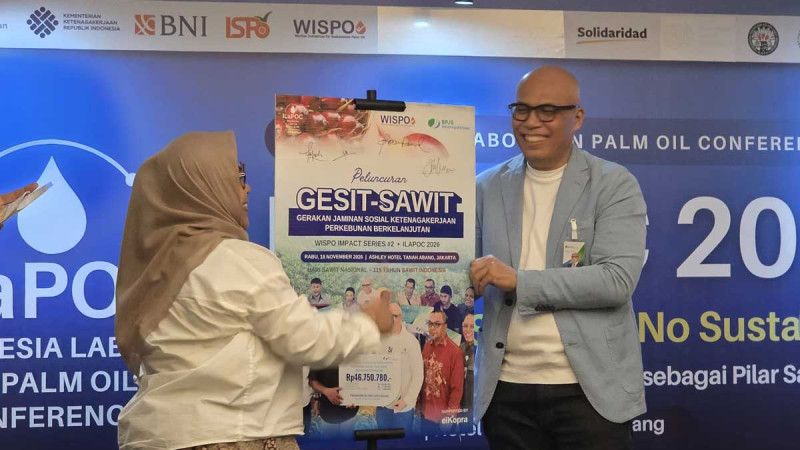
The initiative was launched on November 18, 2026, during National Palm Oil Day and the Indonesia Labour on Palm Oil Conference (ILaPOC) 2026 in Jakarta. It was initiated by Sumarjono Saragih, a member of the Supervisory Board of BPJS Ketenagakerjaan.
According to a statement received by InfoSAWIT on Thursday, November 19, Sumarjono said informal workers remained a major challenge for the national employment social security system. The group includes farmers, agricultural labourers, drivers and small shop owners whose livelihoods are linked to the palm oil economy.
Unlike formal employees, who must be registered by their employers under applicable regulations, informal workers need a different approach to gain access to protection. Many live in rural areas, while BPJS Ketenagakerjaan service offices remain concentrated at the district level.
GESIT Sawit therefore seeks to work with organisations and businesses that already have direct links with workers in plantation areas.
Palm Oil Mills as an Entry Point
A pilot project has begun at a palm oil mill in East Kotawaringin, Central Kalimantan. Under the model, the mill’s employee cooperative is involved as a PERISAI agent, or Indonesian Social Security Movement Facilitator, acting as an extension of BPJS Ketenagakerjaan.
The approach builds on existing business relationships between mills and FFB suppliers. Since farmers regularly deliver their harvests to mills, these facilities have established connections with smallholders in surrounding areas.
The cooperative is expected to help introduce and facilitate social security membership for farmers and informal workers, while also strengthening the role of employee cooperatives in the local welfare ecosystem.
Industry-Wide Collaboration
The scale of Indonesia’s palm oil sector makes broader cooperation essential. The industry spans 26 provinces, around 160 districts and approximately 17,000 villages.
It supports an estimated 16 million workers. Including their family members, around 50 million people are believed to depend on the palm oil ecosystem.
GESIT Sawit aims to bring together businesses, cooperatives, government institutions and other stakeholders to extend protection to workers who remain outside formal employment arrangements.
The initiative reflects a people-centred approach to sustainable palm oil, recognising that sustainability must be measured not only through production and environmental performance but also through the protection and welfare of the people supporting the supply chain. (T2)