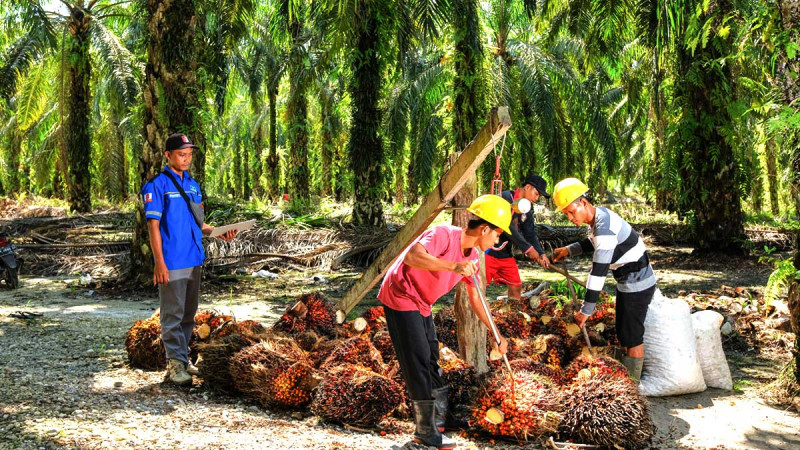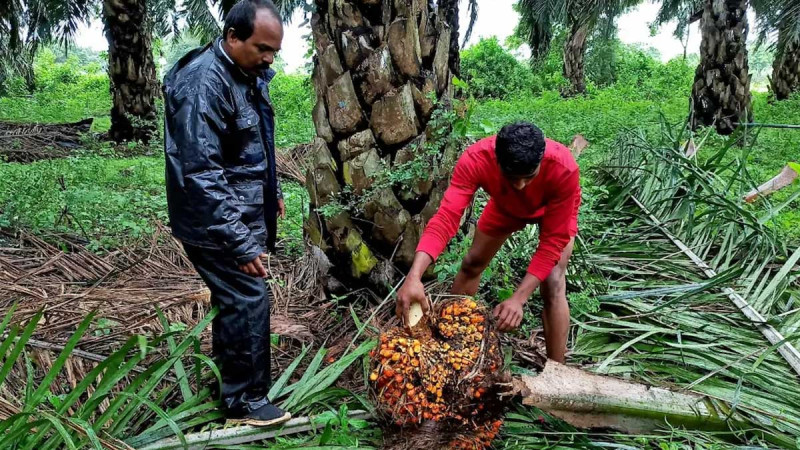
InfoSAWIT, JAKARTA – Indonesia’s drive to improve smallholder oil palm productivity is gaining renewed urgency as industry stakeholders seek to address aging plantations and unlock the untapped potential of nearly 7 million hectares of smallholder-managed oil palm land, which accounts for roughly 42% of the country’s total planted area.
PT Agrinas Palma Nusantara has reaffirmed its commitment to accelerating Smallholder Palm Replanting (PSR), positioning the program as a strategic pillar in strengthening Indonesia’s upstream palm oil sector and improving long-term farmer productivity.
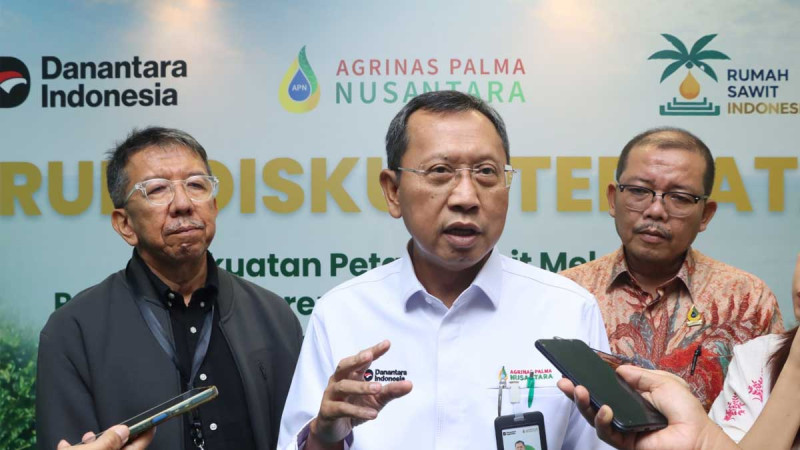
Speaking at a limited discussion forum in Jakarta, Seger Budiardjo, Director of Partnership and Plasma at Agrinas Palma, emphasized that oil palm remains one of Indonesia’s most strategic commodities, playing a vital role in economic growth while supporting downstream industrial development.
“Oil palm is a leading strategic commodity that continues to contribute significantly to national economic growth and the expansion of downstream industries,” he said.
Despite its importance, productivity among Indonesia’s smallholders remains well below its potential. Agrinas data shows smallholder yields currently average 2.6 tons per hectare annually, compared with 3.4 tons per hectare in private estates and 4.8 tons per hectare in state-owned plantations.
One of the main reasons is the slow implementation of replanting programs. Over the past three years, PSR realization has averaged only 20,000 hectares annually, far below national requirements.
Agrinas estimates that around 40% of smallholder oil palm trees—equivalent to 2.8 million hectares—are more than 25 years old, involving approximately 1.1 million farming households.
Without faster replanting, Indonesia risks prolonged productivity stagnation in its smallholder sector, limiting output growth and weakening the competitiveness of its palm oil industry.
To address this, Agrinas has introduced three key acceleration strategies.
First is the implementation of a single management system, aimed at integrating PSR governance into a more effective, coordinated, and efficient framework.
Second is regulatory simplification, achieved through stronger cross-ministerial coordination to reduce administrative bottlenecks that have historically slowed replanting approvals.
Third is end-to-end farmer assistance, covering institutional strengthening, financing facilitation, technical support, and operational guidance throughout the replanting cycle.
Industry observers view this comprehensive approach as essential to transforming Indonesia’s smallholder plantations into a more productive, modern, and sustainable segment of the national palm oil industry. (T2)