InfoSAWIT, JAKARTA – Indonesia’s mandatory palm-based biodiesel program continues to stand out as one of the country’s most impactful energy transition policies, delivering substantial foreign exchange savings, reducing fossil diesel imports, and strengthening domestic crude palm oil (CPO) fundamentals through rising demand from the energy sector.
Since its launch in 2015 through December 2025, the biodiesel mandate has distributed 83.88 million kiloliters of biodiesel, channeling Rp239 trillion in funding, generating Rp750.74 trillion in foreign exchange savings, and cutting greenhouse gas emissions by 222 million tons of CO₂. The program has also contributed Rp21.41 trillion in value-added tax (VAT) revenue, underlining its broader multiplier effect on Indonesia’s economy.
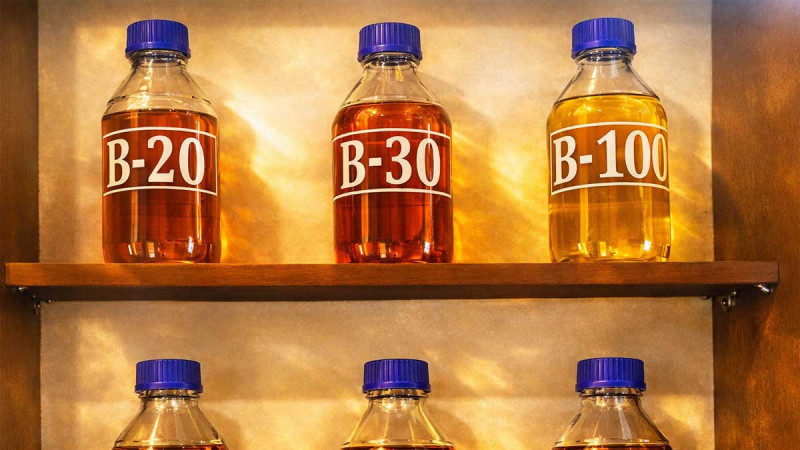
The successful rollout of biodiesel blending mandates—from B20, B30, and B35 to B40, with B50 under preparation—has significantly increased domestic CPO consumption, creating a structural demand base that helps support palm oil prices, particularly during periods of weaker export demand, global trade restrictions, and sustainability-related market pressures.
However, beneath that success lies a growing strategic concern: Indonesia remains heavily dependent on imported methanol, a key raw material used in biodiesel production.
In the esterification and transesterification process, palm oil derivatives react with methanol to produce Fatty Acid Methyl Ester (FAME), the primary component of biodiesel. As blending mandates rise, methanol demand increases in parallel.
Director General of New and Renewable Energy and Energy Conservation at the Ministry of Energy and Mineral Resources, Eniya Listiani Dewi, previously estimated that if Indonesia fully implements B50 for both subsidized and non-subsidized fuel markets, national methanol demand could reach 2.5–2.8 million tons annually.
At present, domestic methanol production stands at only around 600,000 tons per year, far below industrial demand, forcing Indonesia to rely heavily on imports—primarily from the Middle East.
This creates an emerging paradox: while biodiesel reduces foreign exchange outflows by cutting fuel imports, part of those gains could be offset by rising methanol imports needed to sustain FAME production.
To address this imbalance, the government is pushing forward plans to develop a domestic methanol plant in Bojonegoro, East Java, with projected investment of US$1 billion–US$1.2 billion, targeted for completion by late 2027.
Going forward, the long-term success of Indonesia’s biodiesel industry will depend not only on CPO absorption, emission reduction, or foreign exchange savings, but also on building a fully integrated upstream-to-downstream supply chain—including domestic methanol production—to ensure the energy transition is both green and economically resilient. (T2)