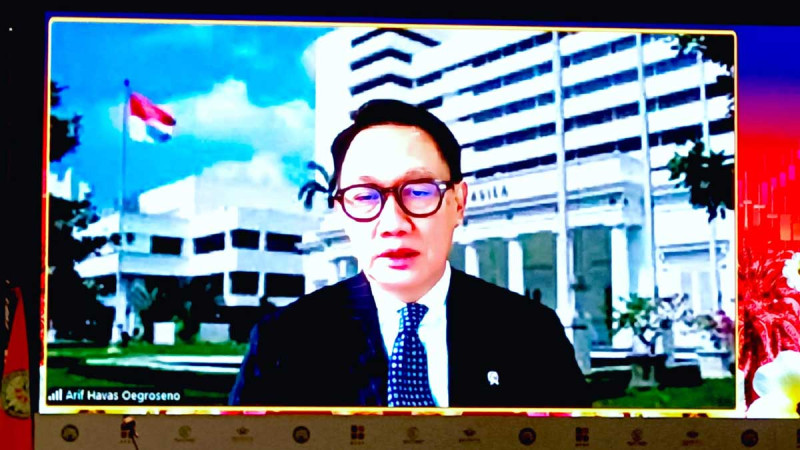
InfoSAWIT, NUSA DUA — Indonesia’s Deputy Foreign Minister Arif Havas Oegroseno stressed the importance of making sustainability principles a universal standard, not a unilateral interpretation imposed by certain countries or regions. He delivered this message during his keynote speech at the Indonesian Palm Oil Conference (IPOC) 2025 and Price Outlook 2026 in Nusa Dua, Bali, on Thursday (Nov. 13, 2025).
Before an audience of national and international palm oil stakeholders, Havas noted that current global geopolitical dynamics are increasingly influencing the direction of global economic and trade policies.
“We are witnessing how geopolitics has entered the realm of business and economics. Many major companies are not yet prepared to anticipate its impact on their business decisions,” he said at the event attended by InfoSAWIT.
He cited examples of energy and natural resource companies in various regions now facing uncertainty due to policy shifts and geopolitical conflicts.
“We are seeing the weaponization of multiple sectors — economy, trade, even technology — now being used as instruments of political power,” he added.
Market Diversification and Emerging Risks
Havas also underscored the need for market diversification in Indonesia’s palm oil industry, given growing uncertainties in traditional markets such as the United States and the European Union. He revealed that the government has expanded trade cooperation with countries in Latin America and Africa.
“Recently, we signed trade agreements worth around US$500 million in Latin America. Africa, with a population exceeding one billion, is also a potential market. We are exploring partnerships with South Africa and Nigeria, including in vegetable oil products such as palm oil,” he explained.
According to him, diversification efforts not only expand export markets but also strengthen Indonesia’s resilience in facing global geopolitical shifts.
“We must position ourselves as a strong player — not merely a follower of global policy trends,” Havas emphasized.
In another part of his speech, Havas highlighted the need to view sustainability not solely from an environmental standpoint but also from economic and social justice dimensions. He explained that these three elements form an inseparable unity recognized as principles of international law.
“Sustainability is not just about protecting the environment. It is also about economic equity and social justice — all three must move in harmony,” he said.
He further asserted that sustainability is not an exclusive value owned by Western countries.
“If sustainability is indeed a principle of international law, its standards must be universal. No country or region should impose its own standard or claim to be more sustainable than others,” he added.
Indonesia’s Role in BRICS
As a new member of the BRICS economic group, Indonesia now plays a strategic role in promoting balance within the global economic order, Havas noted. He pointed out that food security and sustainability have become central themes in the latest BRICS declaration.
“In the BRICS Declaration, particularly paragraphs 69 and 88, member states reaffirm their commitment to strengthening a sustainable global food system, including recognition of the roles of smallholders, women, and local communities,” he explained.
Havas concluded his speech by calling for cross-sectoral and international collaboration to ensure that Indonesia’s palm oil industry continues to advance amid global challenges.
“We must have confidence, because palm oil is not merely an economic commodity — it is a symbol of our nation’s resilience and independence,” he concluded. (T2)