InfoSAWIT, BOGOR – Successful oil palm replanting depends on more than seedling quality and planting techniques. Pest and disease threats during the early stages of growth can undermine replanting investments and generate additional costs that may reach billions of rupiah.
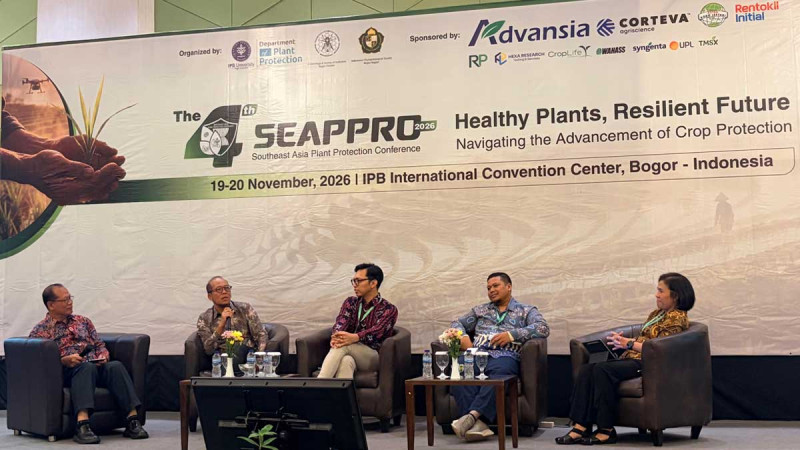
The issue was highlighted by Dr. Bandung Sahari, Director of PT Astra Agro Lestari Tbk, during a panel discussion at the Southeast Asia Plant Protection Conference (SEAPPRO) 2026, held at the IPB International Convention Centre in Bogor on Friday, November 20, 2026.
Speaking at a session titled Trends in Oil Palm Pest and Disease Research, Bandung emphasized the importance of strengthening research to address evolving threats from plant pests and diseases across oil palm plantations.
According to Bandung, two major threats remain a concern for the industry: basal stem rot caused by Ganoderma sp. and attacks by the rhinoceros beetle, Oryctes rhinoceros. Both can cause serious damage, particularly to young palms in replanting areas.
Rhinoceros beetle attacks can damage the growing point of oil palm trees. Under certain conditions, the damage can stunt growth or kill the plants, requiring replacement through infilling.
Meanwhile, Ganoderma sp. remains a significant threat to fresh fruit bunch (FFB) production across plantation areas in Indonesia.
Bandung said plant protection research needs to adopt a more region-specific approach. Differences in geographical and environmental conditions mean that pest and disease types, as well as their levels of severity, are not necessarily the same across regions.
"The palm oil industry can no longer be viewed on the scale of just one or two hectares. It requires a landscape-based approach. Each region has its own characteristics and challenges, so pest and disease management must also be adapted to local conditions," Bandung said in an official statement received by InfoSAWIT on Friday, November 20, 2026.
Replanting Areas Face Significant Economic Risks
For Astra Agro, pest and disease management is a strategic priority, as the company targets replanting approximately 8,000 hectares annually.
Protecting young palms from the early stages of growth is essential to ensuring that replanting investments deliver optimal productivity over the long term.
The potential economic impact can be illustrated through a simulation of infilling costs resulting from rhinoceros beetle attacks.
With an estimated population of 140 palms per hectare and an assumed mortality rate of 5%, approximately seven trees would need to be replaced on each hectare.
If the cost of infilling is estimated at Rp75,000 per tree, covering seedlings, planting-hole preparation, labor, and transportation of seedlings to plantation blocks, the total cost for an 8,000-hectare area would reach approximately Rp4.2 billion.
This figure does not yet include potential losses caused by delayed harvesting, as replacement palms require additional time to develop.
Astra Agro Develops Medium-Resistant Ganoderma Varieties
Basal stem rot caused by Ganoderma sp. presents an equally complex management challenge. The disease-causing pathogen can spread through spores and hyphae, including transmission through the root systems of oil palm trees.
Despite decades of research, no single technology or comprehensive approach has yet been able to fully address Ganoderma infections.
One strategy that continues to be developed is the use of oil palm varieties with improved resistance to the disease.
Astra Agro stated that it has released three varieties classified as Medium Resistant to Ganoderma (MRG), representing an intermediate level of resistance to the pathogen.
The varieties are expected to provide plantation operators with additional options for managing long-term disease risks. However, developing new varieties remains a lengthy process requiring sustained research.
Through its participation in SEAPPRO 2026, Astra Agro is encouraging knowledge exchange and collaboration among industry players, academics, and research institutions.
Such cooperation is expected to produce plant protection research that better addresses field requirements while strengthening the resilience of Indonesia's palm oil industry against pest and disease threats. (T2)