InfoSAWIT, JAKARTA – After a fire, the first figure people usually want to know is how many hectares have burned. Yet that number does not reveal where the affected land is located. A narrow strip of forest may appear insignificant on a map, but if it connects two forest patches, the loss of just a few hectares could cut off orangutans or Sumatran tigers from other parts of their habitat. Who checks whether these corridors remain accessible? And if they have been severed, who is responsible for restoring them?
On November 13, 2026, InfoSAWIT reported on the threat that fires pose to orangutan and Sumatran tiger habitats. Some of these habitats are located within oil palm plantations, including protected areas and High Conservation Value (HCV) areas managed by plantation companies.
When fires reach these areas, companies need to document the damage, regulators must examine the obligations requiring follow-up action, and researchers can help explain the consequences for wildlife.
Who Is Responsible for What?
Minister of Agriculture Regulation No. 33 of 2025 assigns companies the responsibility of identifying protected areas and HCV areas within their concessions and explaining their management to workers and surrounding communities.
Criterion 3.7 of the Indonesian Sustainable Palm Oil (ISPO) standard also requires companies to document the maintenance, management, and monitoring of these areas. Such activities must be conducted at least once a year and reported to the relevant authorities. The regulation's annex uses the term without specifying a single reporting recipient for all plantations.
For ISPO certification, Article 58 and Articles 64–66 of the regulation assign supervisory and guidance responsibilities to the Minister of Agriculture, governors, and regents or mayors according to their respective authorities. At the operational level, these responsibilities are carried out through the Directorate General of Plantations and regional agencies responsible for plantations.
Companies that have not yet obtained certification are also covered by the supervisory framework, while compliance audits against ISPO criteria are conducted by ISPO Certification Bodies.
A single fire incident may involve several government institutions. If habitat protection or fire prevention measures are included in a company's Environmental Approval, environmental authorities are authorized to examine their implementation under Articles 492 and 493 of Government Regulation No. 22 of 2021.
If plantation workers discover injured protected wildlife, the company must document the handling process and report it to the local Natural Resources Conservation Agency (BKSDA), as stipulated under ISPO Criterion 3.8.
The legal status of the affected land also matters. Article 9 of Law No. 32 of 2024 requires business permit holders operating in Preservation Areas to carry out and finance conservation activities and adjust their management practices accordingly.
Therefore, when assessing a company's obligations following a fire, regulators need to examine the company's HCV maps alongside Preservation Area designation maps and the applicable legal documents.
What Can Researchers Contribute?
Universities can begin by examining publicly available satellite imagery. Researchers can estimate which parts of HCV areas have burned, identify remaining intact vegetation patches, and determine locations requiring field inspections.
Such studies can be initiated independently by universities, consistent with the academic autonomy recognized under Law No. 12 of 2012 on Higher Education.
However, once research moves into the field, access arrangements must be addressed. For independent surveys in plantations where access is controlled by companies, researchers must obtain permission from the authorized management. Surveys inside conservation areas must follow the requirements of the relevant area managers.
For official inspections, the government institution requesting academic assistance determines the scope of the expert's work. Environmental compliance inspections themselves remain the responsibility of appointed officials under Minister of Environment and Forestry Regulation No. 14 of 2024.
Researchers are particularly important when monitoring results need to be interpreted.
For example, a lower number of wildlife photographs captured by camera traps this year does not necessarily indicate a declining animal population. A reduction in the number of cameras or a shorter observation period could also explain the difference.
Researchers must examine these possibilities while assessing changes in vegetation cover and the condition of wildlife movement corridors.
If a company finances the research, funding sources, data access, and researchers' freedom to communicate their findings should be agreed upon from the outset. This is essential to maintaining the credibility and accountability of the research.
If preliminary findings indicate that wildlife corridors have been disrupted, the resulting report should clearly identify the affected areas, the authorities responsible for inspecting them, and the inspection schedule.
If the damage is confirmed, the company must establish restoration measures and a schedule for evaluating their effectiveness.
When the research team returns to the site, two questions need to be addressed: Has the vegetation begun to recover? Is there evidence that wildlife has returned to the corridor?
These findings can help companies and regulators determine whether restoration efforts are working or require further improvement.
Ultimately, fires in oil palm plantations are not simply a matter of hectares burned. They can also sever wildlife habitats and threaten the living space of endangered species.
Companies, government authorities, and researchers each have distinct responsibilities in ensuring that protected areas are not merely recorded on maps, but actively managed and restored. (*)
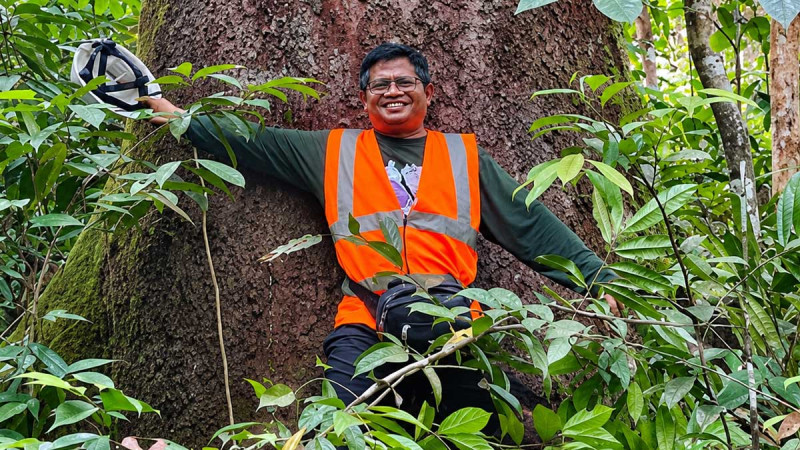
Author: Onrizal is an academic at the Faculty of Forestry, University of North Sumatra, and a researcher at the Center for Tropical Biodiversity Conservation, University of North Sumatra.
Email: onrizal@usu.ac.id
Disclaimer: This article represents the author's personal views and is entirely the author's responsibility. It does not necessarily reflect the editorial position of InfoSAWIT.