InfoSAWIT, NUSA DUA – Slowing growth in global palm oil production amid rising output from competing vegetable oils has become a growing concern for the international palm oil industry. Oil World Executive Director Thomas Mielke has called for industry revitalization, emphasizing plantation productivity improvements and stronger support for smallholders.
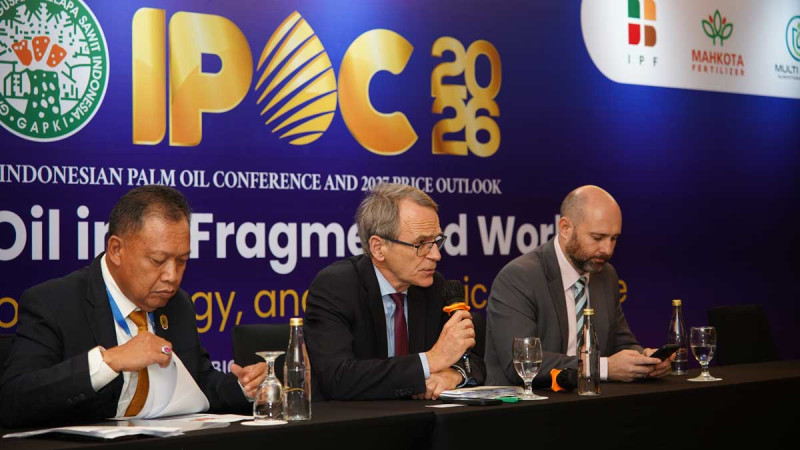
Mielke delivered the remarks at the 22nd Indonesian Palm Oil Conference and 2027 Price Outlook (IPOC 2026), attended by InfoSAWIT on Friday (November 13, 2026), in Nusa Dua, Bali.
He explained that global palm oil production growth has slowed in recent years. In contrast, several competing vegetable oils, particularly soybean, rapeseed, and sunflower oils, have continued to expand their production.
This divergence in production trends, he said, deserves serious attention from palm oil-producing countries. If the trend continues over the long term, soybean oil production could potentially surpass palm oil output.
However, Mielke stressed that such an outcome remains a scenario that should be monitored rather than a definite prediction about the future of the global vegetable oil industry.
He also noted that a study projecting global oils and fats production through 2032, including individual countries' production shares, was still being finalized. Therefore, definitive figures were not yet available.
"My objective today is to highlight my concern about the slowdown in global palm oil production growth, while other commodities, particularly soybean and rapeseed, continue to increase their output," Mielke said.
Smallholder Productivity Needs Improvement
According to Mielke, the changing production landscape can still be addressed through concrete measures by palm oil-producing countries. One of the biggest opportunities lies in improving productivity on existing plantations, particularly those owned by smallholders.
Support for smallholders could include replanting programs using improved planting materials and technology, higher yields, and better plantation management practices.
He acknowledged that various smallholder assistance programs were already underway. However, these initiatives could be expanded to make a greater contribution to national palm oil production.
Productivity improvements should also be supported by stronger cultivation practices and more sustainable crop management.
Industry Revitalization and Sustainable Plantation Development
Mielke also sees opportunities to develop oil palm plantations on land designated for such activities, provided that sustainability principles are maintained.
In his view, industry revitalization should not depend solely on expanding plantation areas. It should also focus on optimizing existing plantations, improving crop yields, and using technology to increase production efficiency.
He warned that if producing countries fail to strengthen palm oil productivity, market forces could eventually reshape the global vegetable oil production landscape.
When palm oil supply grows more slowly, higher prices could encourage the expansion of alternative vegetable oil production elsewhere. Soybean- and rapeseed-producing countries could take advantage of this opportunity to increase their production capacity.
Nevertheless, alternative vegetable oil crops do not always achieve the same level of land productivity as oil palm, particularly in Southeast Asia.
For this reason, Mielke considers productivity improvements and industry revitalization essential to maintaining palm oil's competitiveness in the global vegetable oil market.
His remarks serve as a reminder that the future of the palm oil industry will depend not only on market demand but also on producing countries' ability to raise productivity, strengthen support for smallholders, and ensure sustainable investment in the plantation sector. (T2)