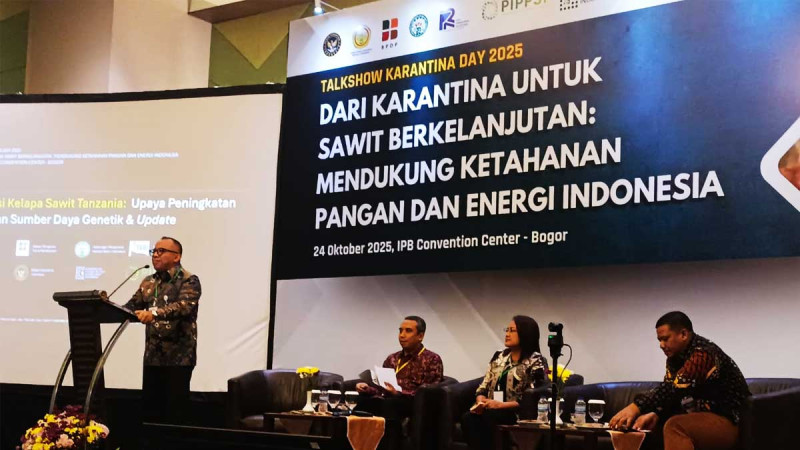
InfoSAWIT, JAKARTA – Senior Vice President (SVP) Business Development PT Riset Perkebunan Nusantara (RPN), Edy Suprianto, affirmed the commitment of palm oil seed producers to continue supporting quality supervision and increasing national sustainable production. This was conveyed by Edy at the Quarantine Day 2025 Talkshow, titled “From Quarantine for Sustainable Palm Oil: Supporting Indonesia's Food and Energy Security”, held on Friday (24/10/2025) and attended by InfoSAWIT.
According to Edy, palm oil seed producers have so far endeavored to follow all rules and standards set by the government, including regulations from the Ministry of Agriculture and SNI Palm Oil Seed Quality provisions. He emphasized that the palm oil seed industry in Indonesia is one of the most tightly regulated sectors.
“From a regulatory perspective, palm oil seeds are commodities with the strictest rules. Producers have tried to follow all provisions, including annual monitoring and evaluation from the Main Center. However, the fact is that many uncertified seeds are still circulating in the field,” said Edy.
He explained that although the national palm oil seed production capacity is quite large—even able to meet 97–100% of market demand every year—however, the rampant circulation of illegal seeds online remains a serious challenge.
“If law enforcement against the circulation of illegal seeds, especially online, has not run optimally, then it will be difficult for us to maintain a healthy and transparent supply chain,” he said.
Edy added that palm oil seed producers are ready to collaborate with law enforcement and government regulators to suppress the circulation of fake palm oil seeds that harm farmers. He also assessed that cross-sector synergy is very important to strengthen the supervision system and maintain the sustainability of the national palm oil industry.
“We from the producer side are ready to cooperate with the government and authorities to strengthen supervision. Collaboration is the key so that palm oil seeds circulating in the market are truly guaranteed in quality,” said Edy concluding his statement.
With increasing coordination between producers, government, and supervisory institutions, it is hoped that Indonesia's palm oil seed supply chain in the future can be more orderly, transparent, and oriented towards sustainability. (T2)