InfoSAWIT, JAKARTA – The recent expansion of peatland fires in various regions is seen as an alarm for the weak national land governance system. Member of Commission IV of the Indonesian House of Representatives, Daniel Johan, emphasized that the fires are not only due to illegal burning but also reflect structural incapacity in land management and oversight, especially in vulnerable peat areas.
Daniel urged the government to immediately reform land governance by strengthening early detection systems and involving local and indigenous communities as active monitoring partners.
“Peatland fires are a complex cross-sector issue. Commission IV encourages coordination between the Ministry of Agriculture, the Ministry of Environment and Forestry (KLHK), and other agencies to ensure that peatland governance is conducted in an integrated, sustainable, and conservation-based manner,” said Daniel, as quoted by InfoSAWIT from the DPR website, Monday (August 4, 2025).
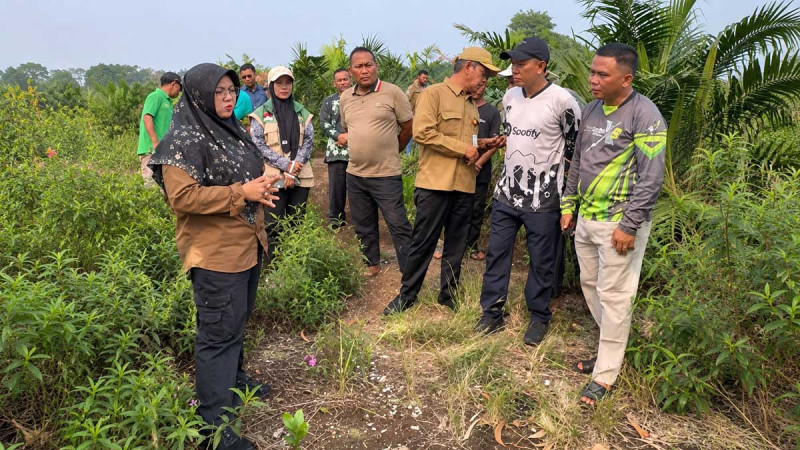
This statement follows the surge in forest and land fire (karhutla) cases in several provinces such as Riau, South Sumatra, East Kalimantan, and West Kalimantan. In Kutai Kartanegara, East Kalimantan, over 200 hectares of peatland have burned. West Kalimantan even recorded 399 hotspots as of July 23, 2025, with significant distribution in Sanggau, Sintang, and Mempawah districts.
Daniel welcomed the central government's efforts, which have deployed water bombing helicopters, weather modification operations, and mobilized integrated teams. However, he believes that prevention remains the most effective and efficient strategy.
“Post-fire management is much more expensive and destructive. Prevention is the key priority that must be emphasized,” he asserted.
He also encouraged the renewal of the land licensing system, which has been deemed overlapping and opens avenues for abuse. Daniel reminded that technology-based monitoring such as satellites and sensors must be complemented by empowering local communities who understand the dynamics of ecosystems traditionally.
“They possess local knowledge that can prevent burning practices. Do not overlook their role as the first guardians of the forest,” he said.
The legislator from West Kalimantan believes that handling karhutla must be comprehensive, from upstream to downstream. He advocates for policies that are not only reactive but also inclusive and supportive of environmental sustainability and the welfare of local communities.
“We must ensure that land management no longer sidelines conservation aspects. The economy of the community and the preservation of ecosystems must go hand in hand,” he stated.
Daniel also reaffirmed his support for strict law enforcement against those responsible for burning, including sanctions against corporations proven negligent or violating land management permits.
“However, law enforcement should not stop downstream. The government must address the root causes and resolve them systematically so that karhutla does not continue to be an annual disaster,” Daniel concluded.
The situation in West Kalimantan is currently declared in a state of emergency due to karhutla. The local government reported a surge in hotspots that are continuously monitored through satellite systems and ground patrols. This situation reaffirms the importance of integrating mitigation efforts, law enforcement, and land governance policy reforms in Indonesia. (T2)