InfoSAWIT, NUSA DUA – Indonesia’s plan to increase its biodiesel blending mandate to B50 should not be assessed solely in terms of energy security. The government must also consider its potential impact on palm oil exports, state finances, and environmental sustainability, according to a public policy expert.
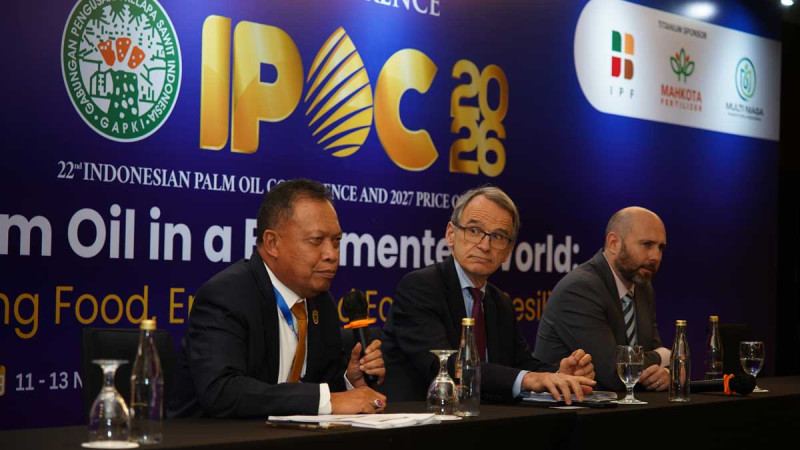
Achmad Nur Hidayat, an economist and public policy expert at UPN Veteran Jakarta, raised the issue during the 22nd Indonesian Palm Oil Conference (IPOC 2026) and 2027 Price Outlook, attended by InfoSAWIT on Thursday (12 November 2026) in Bali.
Achmad warned that expanding biodiesel consumption could have consequences across several interconnected sectors. He said policymakers should avoid making decisions based on energy targets alone, without assessing the broader economic and environmental implications.
One major concern is the potential impact on exports. If demand for palm oil as biodiesel feedstock increases while production remains relatively unchanged, the volume available for international markets could come under pressure.
He pointed to a possible 10% reduction in exports as one scenario that deserves closer examination. The key question, he said, is which sector would ultimately bear the cost if the government maintains its policy direction without making adjustments.
El Niño Adds to Supply Uncertainty
Achmad also highlighted the potential impact of El Niño on oil palm production. Changes in weather conditions could affect plantation output and the availability of raw materials, making it important for the government to incorporate production risks into its biodiesel planning.
The concern is particularly relevant if higher domestic biodiesel demand coincides with weaker production. Such a combination could intensify competition between domestic consumption and export markets for available palm oil supplies.
He argued that discussions on the B50 policy should involve a wider range of ministries and stakeholders, rather than being led solely by the Ministry of Energy and Mineral Resources.
The policy has implications beyond the energy sector, extending to trade, public finance, plantations, and environmental management.
Balancing Energy Security, Fiscal Sustainability and the Environment
Achmad called for a comprehensive policy framework that takes into account three major considerations: energy security, fiscal sustainability, and social and environmental impacts.
On the plantation side, rising demand for palm oil as biodiesel feedstock also needs to be linked to production and land-use policies. If demand continues to increase, there may be greater pressure to expand plantation areas to secure additional supplies.
The government, he said, must ensure that efforts to strengthen national energy security do not create new environmental challenges.
Palm oil and biodiesel policies therefore need to balance energy objectives with responsible land management and environmental protection.
Achmad urged the government to conduct a thorough impact assessment before implementing policy changes. Anticipating potential consequences, he said, would be more effective than responding only after problems emerge.
The success of the biodiesel programme should not be measured solely by the increase in the domestic blending mandate. Its ability to maintain export performance, manage fiscal exposure, protect social interests, and safeguard environmental sustainability must also be considered. (T2)